Monday, August 26, 2013

Corvettes at Carlisle 2013


This was a very, very special Corvettes at Carlisle for a number of reasons:

  1. 60th anniversary of the first Corvette
  2. 50th anniversary of the first Corvette Stingray
  3. Announcement of the new C7 Corvette Stingray
My lovely bride of 30 years came along to keep me from buying a 3rd Corvette :)   Plus, we left there to go have dinner with our son Michael at VT that evening, then went on to Dandridge TN to spend the weekend at Lake Douglas with Julie's aunt and uncle.  We took the 2011 Grand Sport I own that got 27mpg on the highway, which is not bad for 445hp and 325/30 tires on the rear.


 Above is a 1965 Exoto Grand Sport.    I don't know how many millions this is even worth - literally.

Most importantly, Julie looks great in the new Corvette Stingray.

 This is my favorite color of what they currently have in 2014 which is called crystal red.


Above is me with Kirk Bennion of GM who designed the Corvette Stingray! Kirk gave me a Stingray pin that is typically for Corvette team members who actually work at GM which I thought was very cool.


Above is me with Tadge Juechter of GM who is Chief Engineer for the Corvette Stingray!  I spoke with Tadge for 15 minutes without any interruptions which is incredible amount of time with an industry legend.


They have lots of seminars in the GM Engineers Tent (which is where I tend to hang around).


Above I am talking with Jason - who designed the Corvette Stingray's

Above is the cutaway of the Corvette Stingray which is always fascinating to look at.

Below is the C6R race car that has been kicking butt and taking names in the GT2 class and previously the GT1 class prior to 2009.


 Above are the rows of the most famous Corvette of all time - the 1963 split window Coupe. 

Above is the famous knockoff wheel on the C2 Corvettes (1963-1967).


Below is the partial view from the hill at Corvettes at Carlisle in 2013.


Sunday, August 25, 2013

SPARC at 25 Years - GREAT Panel of Computer Industry Legends


I watched this FANTASTIC panel on SPARC - Scalable Processor ARChitecture that had ALL of the Sun Founders - Scott McNealy, Vinod Khosla, Andy Bechtolsheim and Billy Joy as well as Dave Patterson of UCB and the first VP of Engineering Bernie Lacroute and Anant Argrawal who led the first SPARC processor design team and Rick Hetherington who was a microprocessor designer at Sun.

If you are a fan of Sun OR like computer processor architecture discussions this is worth an hour and half of your time.

I was at Sun prior to SPARC, so I remember how all of this came about from a field standpoint.  At the time, the hot chip was a 25MHz Motorola 68020 that was 4 MIPS.  When the first SPARC chip came out, it was 10 MIPS, 16MHz and was manufactured by Fujitsu and was on a pair of 20,000 gate array.  It was codenamed Sunrise.  The first system was a SPARC 4/260 which was a desk side system.  What I remember about the introduction of SPARC was they wanted to have SPARC Ambassadors out in the field.  At the first meeting, Sun's microprocessor engineering team wanted us to demonstrate the advantages of SPARC by showing how SPARC register windows worked with this round piece of paper that had these windows cut in them and you rotated the paper around to show how the INS, OUTS and LOCALS would move.  I remember telling the folks in engineering that while this was interesting, what most customers really care about is end performance as opposed to HOW it was achieving the performance.  Some of Sun's customers did care though.  As Scott used to like to say, "the ideal Sun customer is someone who goes to the bike store and pays more to get a box of parts so they can assemble it themselves."

The really fascinating part of this is not only the history, but the exchange between these computer industry legends.  I especially enjoyed the back and forth between Dave Patterson and Bill Joy around the 1:17:00 mark.

Saturday, August 24, 2013

Bill Joy on Vibrant Data


I ran into this short 2 1/2 minute video on Bill Joy discussing some interesting examples of the pros and cons of vibrant data and thought it was worth sharing on my blog.


Friday, August 23, 2013

Code Monkeys


There is an interesting article at Popular Mechanics by Steve Rousseau on how grease monkeys are becoming code monkeys.  Below are some snippets:

"The phrase "car modification" bring to mind images of grease-stained burly persons clad in oil-spotted coveralls, toiling away at the aluminum and steel heart of some piece of American muscle. Those who coax more out of a vehicle are seen as artisans. Their canvas is an engine block. Their studio, a garage."
 snipped....

"In this respect, Nelson is part of a new class of automotive mechanics that seek to improve the automobile with data sets and text editors instead of wrenches and milling machines. "Look around any high school. For every person who modifies an engine there are about five to ten people who are doing complex coding on a laptop," says K. Venkatesh Prasad, group and senior technical leader of vehicle design and infotronics within Ford's Research and Innovation department."


Thursday, August 22, 2013

MTConnect: To Measure Is To Know is AVAILABLE at Google Play!


My book, MTConnect: To Measure Is To Know is NOW AVAILABLE at Google Play!


MTConnect® Institute Releases New White Paper: Getting Started with MTConnect – Writing Client Applications


Today, the MTConnect Institute released the following press release:

For Immediate Release: August 22nd, 2013

Contact: Dave Edstrom MTConnect® Institute

MTConnect® Institute Releases New White Paper: Getting Started with MTConnect – Writing Client Applications

McLean, Va. – The MTConnect® Institute announces a new white paper, “Getting Started with MTConnect – Writing Client Applications.” This white paper was written for software developers who are interested in writing MTConnect-enabled applications. The primary audience includes software developers who are not in the manufacturing arena but are seeking information on MTConnect in order to create client applications. Software developers who are in manufacturing can still use this white paper as a primer for MTConnect client application development.

MTConnect is a set of open, royalty-free standards intended to foster greater interoperability between manufacturing controls, devices and software applications by publishing data over networks using the Internet Protocol.

This white paper covers the following topics:

  • MTConnect Basics
  • MTConnect Devices and Discovery
  • MTConnect Standard Overview
  • Understanding MTConnect’s XML Schema – Data Dictionary
  • Fault Tolerance and Persistence of Data
  • Requests/Responses – Writing Your First MTConnect App
  • Testing Your MTConnect Clients
  • Hands On Labs and Where To Go For Help

“With the goal of expanding the number of software developers for MTConnect and hopefully the number of interesting applications that are created for MTConnect-enabled manufacturing equipment and devices, this white paper serves a valuable purpose in the world of manufacturing,” said Dave Edstrom, President and Chairman of the Board for the MTConnect Institute and the CEO/CTO of Virtual Photons Electrons. This guide was created by Virtual Photons Electrons, LLC.

The “Writing Client Applications” white paper is the latest addition to the MTConnect Institute’s “Getting Started With MTConnect” series.

This white paper is available at MTConnect.org under: Latest Institute News.


MTConnect® Institute is an organization that develops and provides open standards intended to foster greater interoperability between manufacturing controls, devices and software applications by publishing data over networks using the Internet Protocol (IP). The standards offer a solution to the exchange of data from shop floor devices to higher-level systems. MTConnect.org is the location for information on MTConnect the standard, educational articles, training and MTConnect enabled products. MTConnectForum.com is the site for questions and answers on all things MTConnect.


Wednesday, August 21, 2013

How To Teach Science - What Is a Flame?


This animation was award winning and is the perfect demonstration on taking what appears to be a simple topic, but is actually quite complex, breaking it down, and teaching it in such a way that it is understandable:


Sunday, August 18, 2013

30 Year Wedding Anniversary in Maui


We celebrated our 30 Year Wedding Anniversary in Maui at Kaanapali Beach which was voted the best beach in the world for 2013.

Below is my lovely bride of 30 years.  It was the perfect week.


This was the 180 degree view from our Lanai (balcony) at The Whaler in Kaanapali on the island of Maui.


We had everything that you could ask for within walking distance.


We had GREAT sunsets.  I was rather proud of myself for timing the two sailboats that were crossing just before sunset our last night in Maui on my Nikon Coolpix 9100S that I had keep rebooting because the software was acting stupid (of course) while we were there.  Note, pulling the battery and SD card out for 1/2 an hour is your best bet here to totally reboot.


You never know who you will meet.  Erik Spoelstra, head coach of the twice world champion Miami Heat was at the table next to us the first day with a nice young lady.  Very nice guy.  I told him that he was a young Phil Jackson - NBA coach with 11 rings as a Head Coach and 2 as a player.


We went snorkeling at Honolua Bay and then went for a sail on a multi-million catamaran.


You have to have a convertible in Maui.  An 8 cylinder is the way to go.  I learned the hard way the first time we went to Maui in 1989 when I had a four banger and it could not get past the diesel spewing bus in front of us on the way up to Haleakela - dormant volcano.

Below is a must in Maui - going to Lahina and having lunch at Cheese Burger in Paradise and having a few drinks.


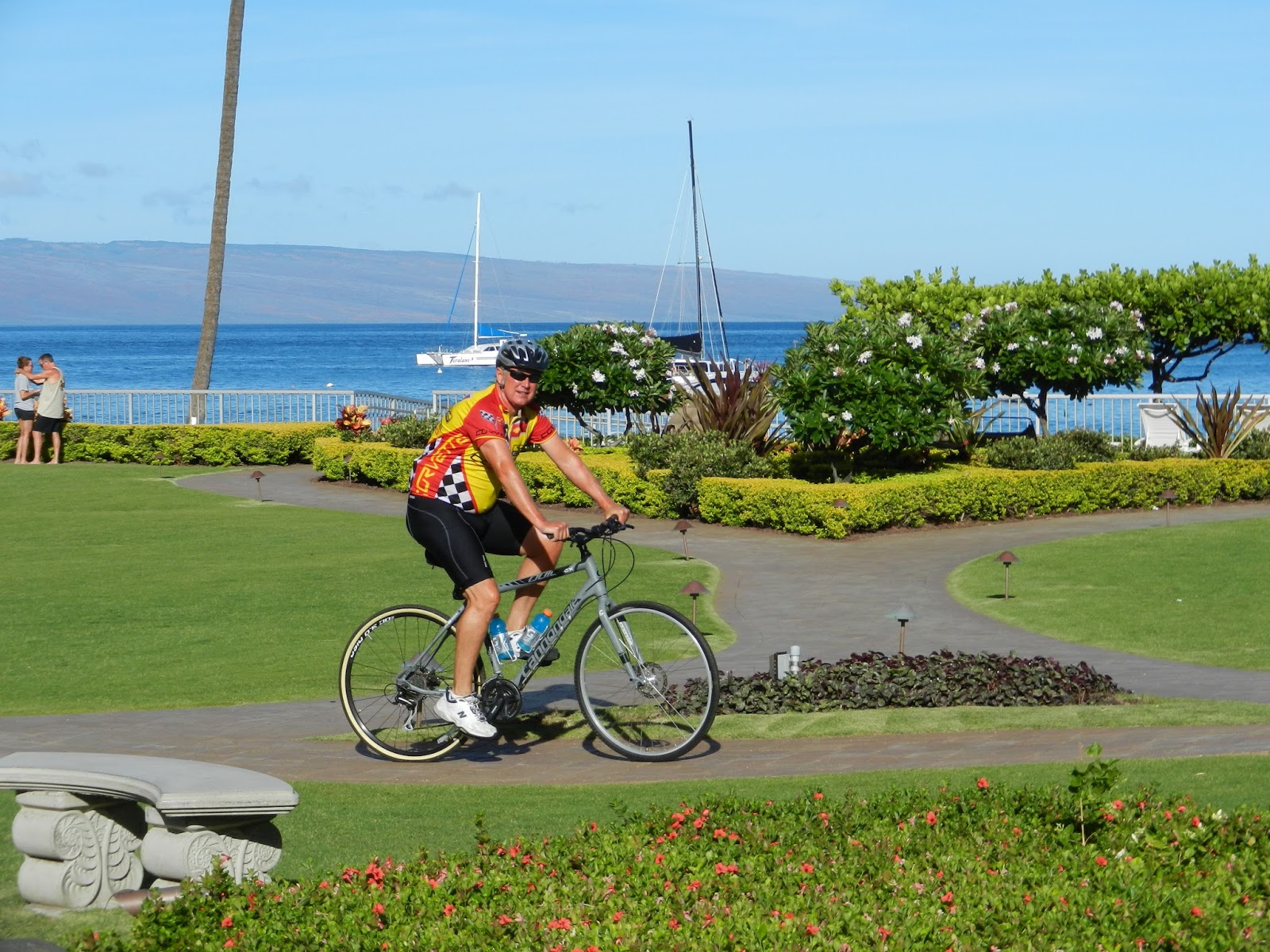
I rented a hybrid and went for a 25 mile bike ride one day.  Hard to beat the views in Maui.


At Black Rock at Kaanapali Beach the kids like to dive off the rocks.  I am sure if my boys would have come along, they would have been doing that as well.  Not me though - not even on a bet.


I went surfing for the first time.  It was a lot harder than I thought.  When we were in Waikiki in 2000, John and Michael were 12 and 10, they went surfing and did great.  Great being that got up every time and surfed all the way in after going 100 yards out.  One of the challenges was the reason the water was breaking where we were at was the coral.  They told us that when you fall off you must do a belly or back flop to make sure that you do not hit the coral that could be 2 to 3 feet below the surface.  With everything you need to remember in terms of getting up (either the pop method or the two step method), getting balanced, riding the waves, looking out for other surfers, worrying about the freaking coral was the last thing I wanted to worry about.  I did get slightly cut and bruised after two hours.  Was it worth it? Absolutely! 


We spent every day at the beach swimming.  Tough life :)

We visited our oldest son John and his girlfriend Janet on the way back.  Here we had lunch at Tony's Pizza Napoletana - best pizza in SF.


Below is Janet, John and Julie at Sutro Baths in SF.


Above we had a great dinner at Caffe Sport.  I was first introduced to this great restaurant back in the late 1980s by Neil Groundwater.  Prior to 9/11, Caffe Sport had three dinner seatings.  They stopped that practice after 9/11 because dinner traffic in general slowed down in the city.

Below is John and Janet in the Sutro Bath area with the Golden Gate bridge in the background.  Americas Cup was going on as well, which was interesting.


[MC]2 2013 Videos NOW Available!


Thanks to AMT's Diyana Hrzic for the GREAT JOB editing ALL of these videos and for Hilena Hailu for getting these organized and posted!

As is stated at the MTConnect Institute's homepage:

[MC]2 2013 Conference Presentations and Videos Released 

Logo MC2The second annual [MC]2 MTConnect: Connecting Manufacturing Conference was held in Cincinnati, OH on April 10-11, 2013. With over 150 attendees, the conference brought together an energetic and inspired group of manufacturers, developers, technology builders, and technology distributors.  It consisted of business and technical tracks, and provided an opportunity to learn from the experts to understand how this game-changing technology is making tremendous productivity gains in manufacturing.  The exhibits, birds of feather sessions, and receptions also gave attendees plenty of opportunities to network.
Visit the [MC]2 2013 page to download presentations and view videos from the conference.

Michael Edstrom's Internship at AMT - The Association For Manufacturing Technology


My middle son, Michael, worked this summer as an internship at AMT - The Association For Manufacturing Technology.  He worked in the Communications Department helping out reviewing and writing articles as well as helping out in a variety of other ways.  AMT is where I consult and is a fantastic organization.  Michael learned a ton and had a fantastic experience.  As a father, I could not have asked for a better experience for one of my sons.  Thanks to all the great folks at AMT for providing this opportunity to Michael this summer! 

Below is a picture of Michael and me on his last day this past Thursday August 15th, 2013.  I could not be more proud of Michael.  He graduates this December from Virginia Tech with two degrees in Professional Writing as well as Creative Writing.  He is going on for his Masters Degree in English in December at VT.


We commuted in together, so Michael had to listen to my radio choices.  He probably got his fill of 60s and 70s music, Howard Stern and NPR :)


Wednesday, August 14, 2013

Manufacturing Authentication and Authorization

By: Dave Edstrom
"On the Internet, nobody knows you're a dog." That’s the caption on a classic cartoon that was created by Peter Steiner and published 20 years ago by The New Yorker. This cartoon has one dog sitting on a chair and typing on a computer while speaking to a second dog that is sitting on the floor. Besides its humor, it also perfectly summarizes the problem with computer security. Specifically, how do you know a person is really who they say they are, and what exactly is that person allowed to do?
In the world of security, this is called authentication and authorization, which are two of the key pillars upon which applications and data depend for safe operations. Think this is just for computer geeks to know? Think again. Security in manufacturing is everyone’s job.
As a shop owner, or plant manager, there are two basics questions that you should ask:
  • Who and what have access to which systems in our plant?
  • Of these individuals and entities that have access to our plant, what are they allowed and notallowed to access and do?
If you or someone in your plant cannot answer these questions immediately, then your security measures could best be described as “crossing your fingers and hoping for the best.” This type of response is typically not a good idea in business. Those two questions fall into the high-level categories of computer security known as authentication and authorization.
Authentication is verifying that an entity (human or system) is who it really says it is, and authorization is what that entity is allowed to do. In the June 2013 edition of IMTS Insider, I wrote about cyber security and manufacturing, and in the July 2013 edition, I wrote about manufacturing passwords. In this round we will take a look at how authentication and authorization work together in manufacturing systems. Authorization is what these entities (human or system) are allowed to do and not do ¬¬¬¬ once you have verified their identities.
There is a misconception that if an individual has ‘password’ or the name of their pet as their password, that it only affects them and their account. The problem with this thinking is that it just takes one open account for the bad guys to get into your system. If you read about computer security break-ins, the scenario is typically the bad guys find a known vulnerability in the system and take advantage of it.
Instead of including a number of long paragraphs on authentication and authorization, I thought it might make more sense to first include a series of questions that should be answered. These are just a few and certainly not an exhaustive list:
  • Do you know everyone who has access to your systems?
  • What are your onboarding security procedures?
  • If an employee leaves, how quickly are they removed from all your systems? This can be a real issue. If you fire a poor performing employee and it takes two weeks to get them out of your system, that’s likely not a good scenario.
  • Is the access just a login name and a password, or is it multiple factor? In other words, if someone steals an employee’s login and password, can they get into your shop or plant, or do you have multiple-factor authentication in place? See my previous article in July 2013 on this topic.
  • Do employees have access remotely?
  • Are your passwords safe? In other words, how easily can the password be guessed or cracked by an intruder? How do you know? Have you run a password-guessing program on your system?
  • What systems have access to what other systems? If someone in the front office leaves his or her system open, could someone get access to the plant or shop floor?
  • Do you have a security firewall in place? Have you run a penetration test on your plant?
  • When employees login remotely, is there a requirement for the security on those machines?
  • Remember, a company’s biggest security holes are always people. If you change your passwords too often and the requirements are too severe, then employees start writing their passwords down and put them in a desk drawer. Or even better, they put a sticky note on their monitor. Take one guess how people find other employees’ passwords?
  • Do you provide access to your suppliers?
  • How does your company protect itself and its employees from viruses, worms, spyware, malware and the plethora of bad software that wants to infect, take over and do havoc on systems?
  • Who has access to equipment on the shop floor?
  • Do you have a network monitoring system?
  • Do you have log files on who is coming and going electronically? Is there a reason an employee should be logging in at 11:30pm on a Friday night?
  • Do you have a remote monitoring system? How is that secured? Is everything encrypted?
  • Do you keep all of your operating system updates current? How about your applications or plugins?
  • If you use Java, is that current? Do you keep older versions of Java around when you don’t need to?
  • Do you have an access control list?
  • How are security policies defined?
  • Is file sharing enabled? How is security handled?
  • Is your Wi-Fi wide open with no security? What security are you using for Wi-Fi? Some systems are easily breakable.
  • When was the last time you spoke to your employees about plant cyber security?
  • If your system was compromised with a security breach, what would you do?
  • Do you have a backup in the cloud if all your systems and the backups were compromised?
  • Most importantly, who is responsible for your shop or plant’s security?
You need to be as serious as a heart attack about protecting your plant or shop’s computer security. If you think you’re too busy to worry about security, then pay someone to come in and do a security assessment.
The only way you can be absolutely sure that you are safe when it comes to cyber security is to not use anything that has a processor or a connection. Unfortunately, that’s not an option for most manufacturers on this planet.
Think about security the same way the Secret Service thinks about protecting the President of the United States – a series of layers with multiple contingency plans. The great folks at the Secret Service ask a couple of simple but very difficult questions:
  • Can we protect the President in this physical location? If the answer is yes, then a detailed plan is put together on how.
  • Second: If something bad happens with the president here, can we secure the area, or do we have to get the President out of here immediately? If the answer is to get out, then a series of options are exercised to determine where and how.
Since abandoning your shop or plant on a cyber security breach is a non-option, then careful planning is your only real course of action. Maybe there needs to be a cartoon showing bots flying around the shop floor on networking cables, stealing parts programs and with the caption, “why do we need to create new designs, when we can just as easily steal them?”
The sad part is that this scenario is real today and it is certainly not funny. Just as protecting the President of the United States is not 100% risk free; neither is protecting your shop or plant from a security breach. The key is to plan with experts, constantly monitor and then continue to update your plans.
Next month, I will continue my series in the IMTS Insider on manufacturing cyber security by discussing Manufacturing Encryption. Just as a reminder, I am just touching on the absolute tip of the iceberg in these series of articles, so if you are not sure about your security practices, please hire a security consultant. Please keep your comments and suggestions coming!

You can place a question here by simply hitting the comment button!

Monday, July 29, 2013

Mazak MTConnect Enables Florence, Kentucky Plant


This is REALLY big news!  This is a great news for Mazak and MTConnect!  

Here are some snippets from the press release.

"In implementing the protocol into the Kentucky operations, Mazak continues its MTConnect leadership and demonstrates its commitment to the protocol as a powerful tool for all manufacturers to improve productivity, machine utilization and efficiency. Mazak has been an ardent supporter of MTConnect since its inception, offering all its machines with MTConnect compatibility. Currently, over 100 Mazak customers are at various stages of MTConnect integration within their own facilities involving approximately 300 machines within a wide range of model types."

“We continue to take a leadership position in propagating the MTConnect open protocol,” said Brian Papke, president of Mazak Corporation. “MTConnect’s value to our customers is in the ability for them to establish extensive and open channels of communication for plug-and-play interconnectivity between devices. MTConnect allows software to be universally applied between different types of machine models so that information is readily available for improving machine tool utilization. Using this capability, Mazak is taking another positive step in further increasing the productivity of our North American operations and ensuring the strong competitiveness of our
Kentucky manufacturing.”
 "According to Neil Desrosiers, Mazak’s developer of digital solutions, the full improvement potential resulting from MTConnect at the Kentucky plant will be achieved when the measurement data is collected and full potential machine tool utilization is realized in the factory."

Canadian Industrial Machinery Article - The Internet Comes to Manufacturing


Joe Thompson wrote a great article for Canadian Industrial Machinery that was titled:

The Internet Comes to Manufacturing

The digital age has arrived on the shop floor, increasing process speed, reducing nonproductive time.
Joe starts off the article with, "If data is being collected, then it should be used. And, once again,new technology enables this."

Dave Edstrom

Joe goes on to say, "Imagine anywhere, anytime access to all facets of your manufacturing process."
Edstrom also is the author of MTConnect: To Measure Is To Know, a book that addresses how open-source, royalty-free standards systems can revolutionize the business of manufacturing.

Cloud computing has potential to be game-changing technology in manufacturing for everyone from small shops to extremely large manufacturing plants. The key is understanding the process, asking the right questions, and making wise decisions.

“Cloud computing is important for manufacturing because it allows companies to avoid the countless business and technical issues associated with running their own data centers and save money by paying only for the computing resources when they need it on a pay-as-you-go model,” said Edstrom."

Friday, July 26, 2013

President of Network Appliance's Complacency Kills Article


There is a great article at Forbes titled, Complacency Kills, on how big companies die.  It is written by Tom Mendoza, president of NetApps at Forbes.  Having lots of former Sun Microsystems employees at NetApps, I know for a fact they do truly care about culture and their employees.

Here is a snippet:

"Here’s how to recognize complacency and fight it.

In the 1980′s, Digital Equipment was a powerhouse, seemingly unstoppable. But Digital got complacent. It failed to respond to technological changes—and it was gone in ten years.
In 2000, what would you have bet that Sun Microsystems would still be in business by 2010? It would have been a bad bet. Sun was on top of the world then, but by 2008, its stock had lost 80% of its value and it disappeared the next year. Sun’s sprawling corporate headquarters now houses Facebook.
These and other companies failed for many reasons, but complacency was front and center. Why didn’t they do something about it?"

75 Mile Bike Ride


Yesterday was a picture perfect day for a bike ride that started out 20 miles with my wife Julie and ended up being a 75 mile ride.  Julie and I rode together from Leesburg to Purcelleville and back (20 miles total).  This is all part of prep for the Seagull Century that I ride in every October with long time friend Jeff Stone.

Below was my speedometer.


Wednesday, July 17, 2013

Sun Founder's The Computer History Museum


Today is the SunDC Sun Microsytems Reunion at Coastal Flats.  Here is the video on the Computer History Museum that was the founders of Sun talking about Sun's history.  I was there in the 3rd row.  I asked Bill Joy and John Gage to retell the "Network Is The Computer Story" which I heard both Bill and John tell me on separate occasions when were having dinner together in Aspen and Georgetown repsectively.  It was a great night listening to Andy Bechtolscheim, Vinod Khosla, Scott McNealy and Bill Joy.


In the photo above, I asked Bill Joy to retell the story of how "The Network Is The Computer", which came about at the 1:43:40 mark in the video below:


Sunday, July 14, 2013

Great Week in Ocean City, Maryland with the Franklins of Marshall, Wisconsin


Julie and I spent a week in Ocean City, Maryland with Bobbi and Richard Franklin (my cousin) of Marshall, Wisconsin as well as their daughter Tayor and Taylor's friend Kimberly.   Below are some of the highlights.


The first mandatory health stop if to Thrasher for their world famous boardwalk french fries with vinegar - NO KETCHUP as they like to say :-)

Early morning view from out balcony of the three umbrellas and four chairs I set up at 7:30am every morning.


Little blurry, but they showed movies on the beach in front of our condo.

Bobbi Franklin and Julie


Taylor Franklin and her friend Kimberly.


Julie and me at our new favorite restaurant in Ocean City - the Harborside Bar and Grill which are known for their orange crushes.  You have to like any restaurant that has a sign the "bikers can not wear their colors".   They are not talking about your Lance Armstrong Trek jersey either.


Above is the orange crush from the Crabcake Factory which Julie and I ate at twice since it was just one block from our condo on the ocean side.

Richard and I like to compete on everything.  Below is me kicking his butt boogie boarding! :-)


One of the highlights was the 46.2 round trip Ocean City to Rehoboth bike ride that my cousin Richard and I took one day.  We had a 16 to 20mph southerly tailwind, so we flew up there.  Not so easy on the way back.  This was a distance record for Richard.  It was also tough because he broke a spoke and the bike shop in Bethany did not line the rear tire up correctly when they fixed his spoke on the way back, so his brake was rubbing all the way from Bethany to OC and we did not realize this until we got to OC.


Some fireworks on the 4th of July.  We sat out in front of Bobbi and Richard's tennis courts to have a great view on  a perfect night.


Robot Operating System (ROS) and MTConnect Video


This is a great 8 minute video Robot Operating System (ROS) and MTConnect video that demonstrates how two open systems can work together to change everything you know about manufacturing.  This is a game-changer...