Tuesday, August 2, 2011

The Perfect Mediterranean Summer Vacation

This was the third time that the Edstrom's of Ashburn have spent almost a month in Europe.   In 2005, we went with my parents and my sister to celebrate my parents 50th wedding anniversary.  My father said he would pay for a European vacation if I picked up the flights.  I said yes immediately.  It was easy to say yes when you have over 750,000 miles on United Airlines :-)   In 2008, we did our second European vacation to celebrate me and my wife Julie's 25th wedding anniversary.  My parents came along for that as well.  This trip was to celebrate my wife Julie's upcoming 50th birthday.   It was Julie, John (23), Michael (20), Tim (17) and me.

Wednesday Julie, Michael, Tim and I flew out to Rome to meet John who was already in Europe since May 12th backpacking through Europe and staying at hostels.  Thursday morning we met John at Hotel Artemide in the center of Rome


  We walked around Rome to check out the  Colosseum, Forum  and the Spanish Steps.


Pat McGibbon ordered me to wear my MTInsight t-shirt all over Europe to drive up sales.  Here I am at The Colosseum sight seeing and taking MTInsight subscription orders.


Friday we took one of those open double decker bus cruises to see a large part of Rome    We went on a guide tour of the Vatican, Sistine Chapel and St. Peters Basilica   Tim and John climbed to the top of St. Peters Basilica.  As we walked into
St. Peters Basilica, Tim said, "I forgot how massive this place is. We're talking Appleby's at Fair Oaks massive".


Julie and I in front of St. Peters Basilica.


The Monumento Nazionale a Vittorio Emanuele II (National Monument of Victor Emmanuel II) or Altare della Patria (Altar of the Fatherland) or "Il Vittoriano" is a monument to honour Victor Emmanuel, the first king of a unified Italy, located in Rome, Italy. It occupies a site between the Piazza Venezia and the Capitoline Hill. The monument was designed by Giuseppe Sacconi in 1885; sculpture for it was parceled out to established sculptors all over Italy, such as Angelo Zanelli.[1] It was inaugurated in 1911 and completed in 1935.[2]  (This is all from WikiPedia)


Michael notice the Beamish logo on top of the Bull Dog Bar in Rome.  We had heard of this bar on the tour bus.  John, Michael and I went in for a few beers.  Michael and John drank Beamish and I stuck with Fosters.  I bought a round for two Alaskans - Tony and Chris. 


Sunday we slept in.  Julie, John and I climbed to the top of St. Peters Basilica.  That is really a must do in my opinion.   You could fit the Statue of Liberty inside the Basilica with room to spare. 

Monday Julie and the boys went to the catacombs and I went on a full day walk beyond Vatican city and throughout Rome.   I had lunch at La Sofitta my favorite restaurant in Rome.   We had a great dinner at Anthony Bourbaines favorite restaurant in Rome called La Sporita.


Above is the huge gold globe inside the Vatican that our guide spun for us.


 Tuesday we went Civitavecchia and got on board the Mariner of the Seas.

 Above are two pictures of our ship - the Royal Carribbean's Mariner of the Seas
 The HD LCD tv rotated between the bedroom area and the living room area.


  Above are multiple photos of our Owners Suite or the Henry Hudson Suite.  The boys also had their own suite as well.

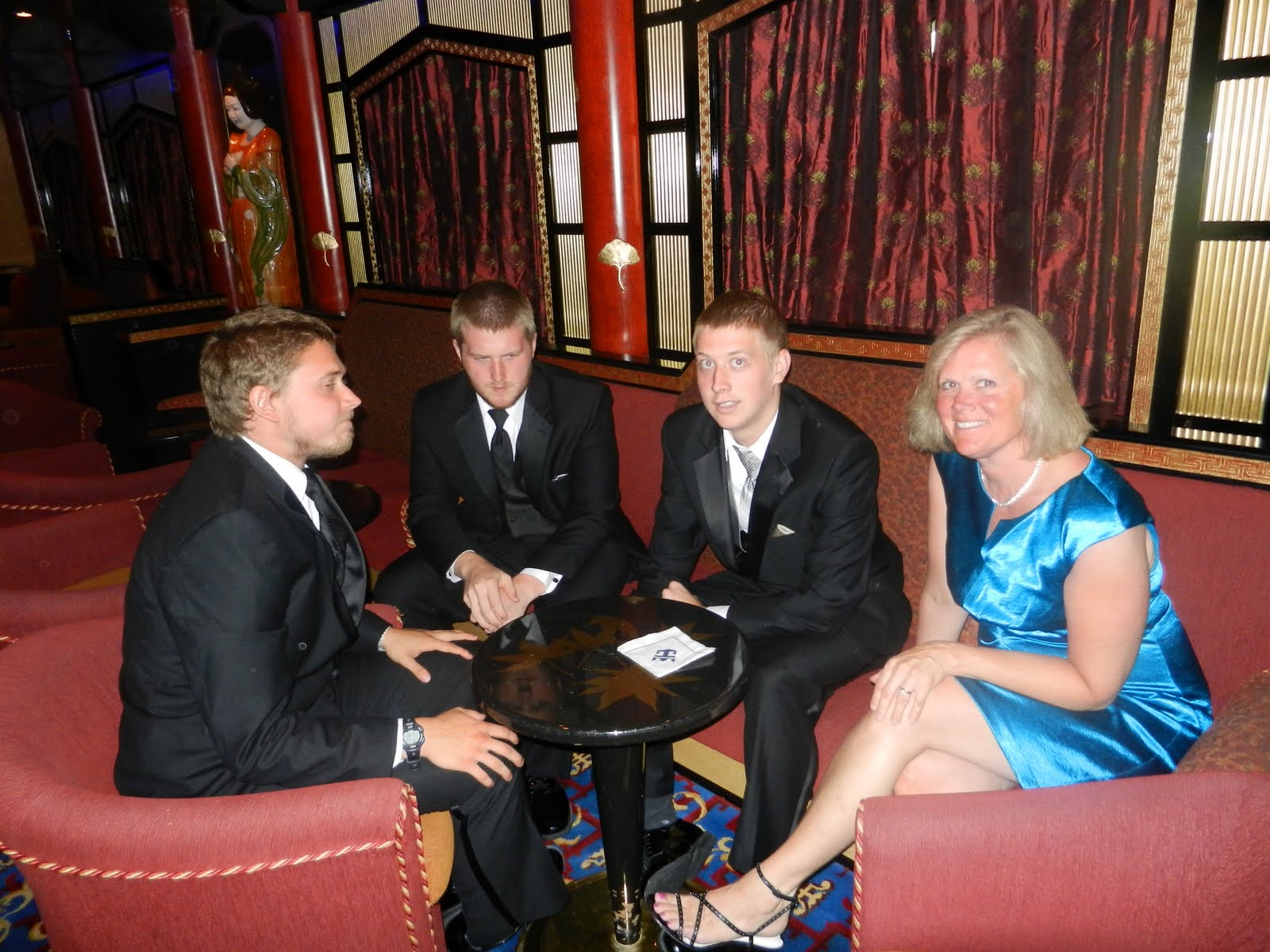
There were three formal nights.  We arranged to rent the tuxedos and shoes from the ship so we did not have to carry them around. 


Here I am talking with the Master (THE Captain) of the Royal Caribbean Mariner of the Seas.  When you have a big suite, you get invited to all of these meet the Captain type of events and this is the first evening.   The Captain is 100% Norwegian.  I told him that I was 1/2 Swedish and 1/2 Norwegian - which I am.  We got into a discussion about Norway vs. the United States.   The Captain said that Norway was a better country than the US.  I said, "well it depends."  Let's say you want your child to have the best opportunity to be an entrepreneur, then the US would be best.  He disagreed.   I said, "let's play a game Captain. I will name three inventions of the US and then you name three from Norway.   The telephone, the personal computer and the Internet.  Your turn.  Top those."  Julie gave me the, "don't piss off the Captain the first night!" looks :-)

Here we are in front of our all time favorite restaurant in Rome -

la Soffitta Renovatio

Our second favorite restaurant in Rome was the one that Anthony Bourdain went to (but never gave the name) that Tim found for us called:  La Taverna del Porto


   We had the Owners Suite and the boys had the The Grand Suite.  We both had access to the Concierge Club which is free drinks between 6 and 9:30.


Wednesday we were in Sicily.    We went on a winery tour, The Godfather tour, Mt. Edna,  and to Savoca where we went to the bar where Michael Corleone (Al Pacino) meets Apollonia (Simonetta Stefanelli).


Here were are at Savoca.

Thursday was an at Sea day


This is Corinth in Italy.
Friday we were at Athens.
Above is the protests in Athens getting ready to happen in the next hour according to our private tour guide.


 Saturday we were Ephesus.     Julie fell and the guide said,  "there are 35 ways to say fall in French".   Tim immediately shot back for all to hear, "I thought there were 35 ways to say surrender in French?"  That's my boy! :-)


Above is me in the water.   I was not planning on going swimming, I was walking around the city trying to Julie and the boys.  That is our ship in the background.


Above is where the Rhodes of Collosus supposedly stood. Sunday was Rhodes and it was amazing.    Michael and Michael were our tour guides.    They did not know where Collosus of Rhodes actually stood which I thought was hilarious.


This is the view from Lyndos on Rhodes.
Tim is breathing hard because he just inched me out in a 150 yard dash.  John came in a distant third.   I should not have given them the 25 yard lead :-)

   Julie, Tim and John took the donkeys  up     Michael and I are not donkey people :-)   We had a snack at a small restaurant
We had lunch at the old castle area at Rhodes.   They forgot my lunch and John said, "they just forgot the wrong guys lunch".   When I asked what happened they said the computer forgot.   I said since the computer forgot, the computer can buy me a big beer. 


Monday was Crete.   We had a very nice winery tour owner son and owner at the Dourakis Winery.     Lake Mournas was dirty and nasty with snakes (per our driver).   John said it reminded him  of Lake Accotink.  We left quickly.  Ocean beach very nice.


Tuesday day at sea.


Above is inside the Blue Mosque.


Wednesday and Thursday was Istanbul.  Istanbul was very interesting.

Friday was the All Access Tour.  It was great!

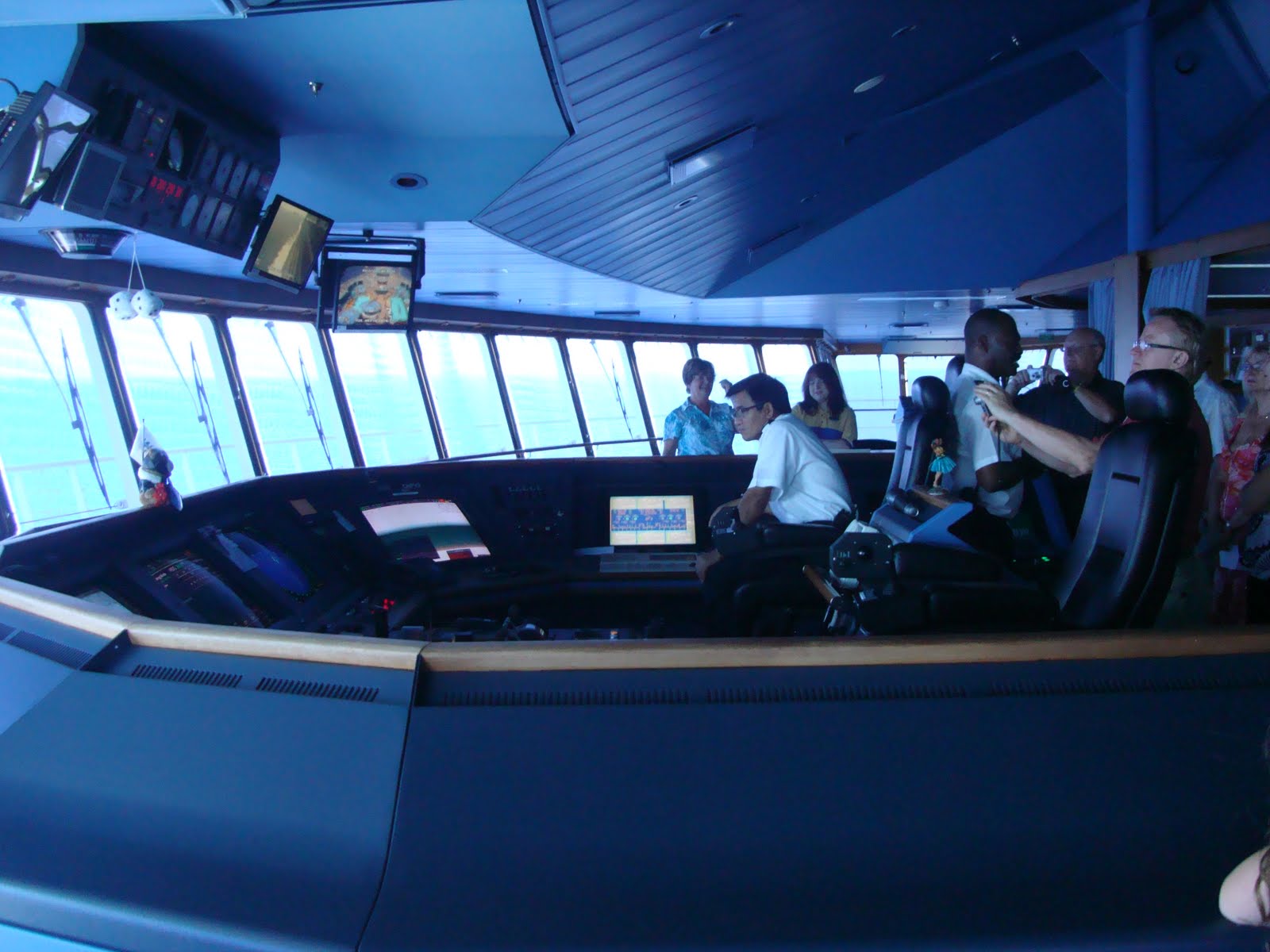
Saturday was a sea day.  Julie and John went on a bridge and galley tour.


Sunday Naples and Pompeii. 


Since we had suites, we had our own concierge club with the other suite holders.  Many times, were the only ones there.  From left to right - Newman, Shravan, John, Michael, Julie, Tim, me and Lucca  Free drinks and food :-)

Monday. Lido Ostia.   Julie and I had a great dinner

I am sure I will had more photos later if you got to this point :-)

PE-RSA-N-IRC - mnemonic
Pompei, Ephesis, Rome, Sicily, Athens, Naples, Istanbul, Rhodes, Crete

Sunday, July 31, 2011

Dennis Govoni Kinecting

This is the first time that I saw someone use the Kinect by Microsoft.   I am not sure that Dennis Govoni is the target audience :-)


Saturday, July 30, 2011

MTConnect Institute Signs Agreement with DMSC


I am very pleased to announce that, as President and Chairman of the Board for the MTConnect Institute, I signed an memorandum of understanding (MOU) with  Curtis W. Brown, President of Dimensional Metrology Standards Consortium (DMSC).  Paul Warndorf, VP of Technology and CTO for AMT, did all the smart and hard work to make this a reality.


What is metrology?  As wikipedia states:


Metrology is the science of measurement. Metrology includes all theoretical and practical aspects of measurement. The word comes from Greek μέτρον (metron), "measure"[1] + "λόγος" (logos), amongst others meaning "speech, oration, discourse, quote, study, calculation, reason".[2] In Ancient Greek the term μετρολογία (metrologia) meant "theory of ratios".[3]
 Why is this MOU important?

This MOU is very important because DMSC has invested in a tremendous amount of hard work in metrology, just like we have in the open and royalty free protocol called MTConnect.  In my opinon, the combination of DMSC and MTConnect is the absolute perfect marriage.   The goals of this joint effort are:


  1. To generate freely accessible standards and specifications which enable interoperability and enable more tightly integrated production and quality in manufacturing.
  2. To enable compliant implementations of those standards and specifications.
  3. To freely distribute the standards and specifications resulting from the joint effort to any party with a material interest in those standards and technologies, including manufacturing companies, suppliers, distributors, end users, technology providers, software developers, independent software developers, value added resellers, system integrators and trade media organizations.
  4. The principals will Principals will communicate how joint efforts can be used to improve manufacturing and business effectiveness, efficiency and quality

 Here are important aspects of metrology - again from wikipedia:


Mistakes can make measurements and counts incorrect. Even if there are no mistakes, nearly all measurements are still inexact. The term 'error' is reserved for that inexactness, also called measurement uncertainty. Among the few exact measurements are:
  • The absence of the quantity being measured, such as a voltmeter with its leads shorted together: the meter should read zero exactly.
  • Measurement of an accepted constant under qualifying conditions, such as the triple point of pure water: the thermometer should read 273.16 kelvin (0.01 degrees Celsius, 32.018 degrees Fahrenheit) when qualified equipment is used correctly.
  • Self-checking ratio metric measurements, such as a potentiometer: the ratio in between steps is independently adjusted and verified to be beyond influential inexactness.
All other measurements either have to be checked to be sufficiently correct or left to chance. Metrology is the science that establishes the correctness of specific measurement situations. This is done by anticipating and allowing for both mistakes and error. The precise distinction between measurement error and mistakes is not settled and varies by country. Repeatability and reproducibility studies help quantify the precision: one common method is an ANOVA gauge R&R study.
Calibration is the process where metrology is applied to measurement equipment and processes to ensure conformity with a known standard of measurement, usually traceable to a national standards board.

Friday, July 29, 2011

TIOBE Programming Community Index for July 2011


This is the TIOBE Programming Community Index for July 2011.  As is stated on their home page:

TIOBE is specialized in assessing and tracking the quality of software. We measure the quality of a software system by applying widely accepted coding standards to it. 

It is interesting to see what languages are the most popular on the web and which ones are up and coming.  Below is a brief description:


"The TIOBE Programming Community index is an indicator of the popularity of programming languages. The index is updated once a month. The ratings are based on the number of skilled engineers world-wide, courses and third party vendors. The popular search engines Google, Bing, Yahoo!, Wikipedia, YouTube and Baidu are used to calculate the ratings. Observe that the TIOBE index is not about the best programming language or the language in which most lines of code have been written.

The index can be used to check whether your programming skills are still up to date or to make a strategic decision about what programming language should be adopted when starting to build a new software system. The definition of the TIOBE index can be found here"

Thursday, July 28, 2011

Java SE 7 Arrives - Based On OpenJDK

One of my favorite development online software sites is Software Development Times known as SD Times.  I am really glad to see that Mark Rheinhold is still with Oracle and the Chief Architect for Java and that Oracle is using OpenJDK as the basis for Java SE 7.  Below are a few snippets from the article Java SE 7 Arrives - Based On OpenJDK :

"We started with proven technology, added in a great community, and then finally added our own commitment and investment. We're standing on the shoulders of giants. In the 15 years of Java history, we've been lucky to build up a giant base of 9 million developers. It's the No. 1 choice by developers according to the TIOBE index, and more than a billion computers around the world run Java. It's by far the most widely deployed language in the history of computing."


"The OpenJDK forms the basis for Java SE 7, marking the first time in history that an open-source version of the Java development environment has been used as the basis for a commercial release. Mark Reinhold, Oracle's chief architect for the Java platform, said that the new open-source development process has been a success, despite a few bumps in the road, such as the Apache Foundation's sudden resignation from the JCP."

Friday, July 22, 2011

Dulles Sets Heat Record at 105 Degrees on Friday July 22nd, 2011

105 Degrees on Friday July 22nd, 2011 Hottest Day EVER at Dulles Airport.

Today is our 20th day of 95+ weather this year here in D.C.

Dulles International Airport, VA (IAD):

This breaks the old all-time record high of 104 set back in 1988 and 1983.

Tuesday, July 19, 2011

[MC]2 Video - Why You MUST Attend!

Why should YOU attend the MTConnect Connecting Manufacturing Conference?  Watch below!

Sunday, July 17, 2011

In a World Without Fences, Who Needs Gates?

In a World Without Fences, Who Needs Gates?

NOTE:  I wrote this for the July 14, 2011 IMTS Insider

No, I am talking about my all-time-favorite Java One T-shirt. I am talking about sales strategies. "Give away the razor and sell em' the blades." We have all heard and seen this type of sales strategy. The standard model is to come up with a proprietary product, separate the consumables and make your money selling the consumables. Specifically, sell the main product at a greatly reduced price and then lock them in forever on your proprietary consumables.

We see this type of sales model in all types of businesses. It is not uncommon to see this scenario in the computer industry and manufacturing. When this is done, it is not quite as obvious as the razor/blade scenario and it is certainly much more expensive. How software vendors do this is very slick because of the sales story that gets wrapped around it. If you do not take the time to think through the life cycle of your software purchase, you can easily fall into this trap. Here's how to avoid it.

I have had this discussion more than a few times lately and the conversation usually starts off with questions on monitoring their shop or plant floor. "Dave, why should I care how I get my data? All I care about is the information I see on my monitor that tells me how my machine tools are running." My response is, "You're right; on one hand, you shouldn't care, unless you think your shop will change or you plan on using the data coming off those machine tools in something besides monitoring."

The software sales rep typically responds with, "Don't worry about it, it's just a black box," when the shop/plant owner asks how the software will connect to the manufacturing equipment. The conversation might end at that point and the customer goes ahead and buys the software.

At this point, the software sales rep knows they have locked the customer in when changes at the shop or plant occur. As we all know, changes always happen in business. The scenario unfolds as follows. The customer calls up the sales rep and says, "We just purchased a new machine tool and I would like to connect it to my monitoring software. What do we need to do in order to make that happen?" The sales rep then has two responses. Either they have the adapter for the new machine tool or they don't. If they do, then there is usually a charge for the adapter, as well as a charge for someone to come out from the software company to install it. If they don't have it, then they will offer to have someone from their professional services organization give a price for writing the adapter. This is typically someone who will cost $150 to $250 an hour to write that adapter. If you decide that you want to integrate the monitoring software in with other software from your existing enterprise, then you will likely be charged to have this type of integration work done as well.

The price can be high, so it is natural to think about different ways that you might be able to get the adapter written for less money. Getting a consultant naturally jumps to mind! You reach out to a few consultants and they all tell you the same story. The software company does not document how to write adapters or how to integrate with their software. You are locked in with the vendor. You are now in what I like to call "adapter hell." This adapter hell is why only 4 to 5 percent of all machine tools are monitored today.

Adapter hell is why it absolutely does matter how the adapters speak to the manufacturing equipment. How would it be different if you had an open and royalty free, as well as open source, type of protocol for the adapters such as MTConnect®? 

MTConnect® speaks in the exact same language that runs on the internet today – http and XML. The beauty of http is that it is the same protocol that moves information around that you also see in your browser bar when you type in http://ESPN.com. XML stands for eXtensible Markup Language and is the data language of the internet. In other words, it is the letters, words and dictionary that describe the data itself. Here's the bottom line with MTConnect – it gives you freedom. It gives you the freedom to have someone else besides the software vendor provide the adapters for you.

Instead of being in adapter hell, by using MTConnect you end up in adapter heaven. Since MTConnect is open source and based on standards, it is easy to find someone to write an adapter. You are not locked into the vendor. Since MTConnect is based on XML, it is brain-dead-easy to integrate that information into your other software.
So, does it matter HOW you get the data? It depends. Would you rather go to adapter heaven or adapter hell? Gates are what some software vendors want to put up so they can charge you outrageous prices for adapters, as well as very expensive installations of those adapters. That is why in a world without proprietary fences, who needs software adapter gates? How do you avoid adapter hell? The next time a software sales rep tries to tell you, "It's just a black box, don't worry about it," make sure you ask that person HOW they are getting the data and make sure that software vendor has MTConnect as an option.

Adapter heaven is much better place than adapter hell.

Japan Beating USA in Woman's World Cup

WOW!  What a game! Congratulations Japan woman.