Saturday, December 11, 2010

Tim's Accident Avoidance School at Summit Point

I have taken all three of my sons to the Accident Avoidance School at Summit Point Motorsports Park.

Today,(December 11th, 2010)  I took Tim (my youngest son) and Steve Ferry brought his son Matt as well.  Steve and I learned of this course back in 2001.  I took my oldest son John to this (June 18th, 2005)  as well as my middle son Michael (April 6th, 2008).  I do this when my sons are in the junior year of high school after they have had 6 months of driving experience.

It was very cold, but that actually improved the course with the light snow and ice on the tracks.  The boys did great, learned a lot and got a tremendous amount of hands on driving time.  The course was $345 and is well worth it.  In addition, many insurance companies give discounts for attending these types of courses.
BSR’s specialized Accident Avoidance training included both classroom and lots of hands-on driving.

The key points out of the class are:
  • Look where you want the car to go.  The car will go where you eyes are looking.
  • Look where you want the car to go.  The car will go where you eyes are looking.
  • Look where you want the car to go.  The car will go where you eyes are looking.
  • The first three rules above are the key top accident avoidance as the BIGGEST mistake the people make is staring at the wreck in front of them, starting at the tree off on the side of the road, staring at the deer in the middle of the road.
  • You have three inputs:
    1. Steering
    2. Brakes
    3. accelerator
  • Of those three, the most important is the steering.  The biggest mistake people make is locking up the brakes and staring at the one thing they want to avoid.  Be gentle on the brakes, to keep road contact so you keep control and use steering to aim where you are looking (which is where you want the car to go).
  • When driving, you want to look as far down the road as you can.  Your peripheral vision is NOT just what is on your sides, but also what is in front of (between where your eyes are looking down the road and in front of the car.)
  • Keep your hands relaxed at 10 and 2 with your thumbs pointing up on the steering wheel.
  • When you adjust your legs, you should adjust with your foot on the brake pedal, not the accelerator.
  • Place your right foot directly in front of the brake pedal, keep your heel in front of the brake pedal as you rotate your right foot to use the accelerator. 
  • When you are braking, the objective is to be doing a threshold type of braking.  Threshold braking is very important to fully understand.  Below is from wikipedia on Threshold braking:

"Threshold braking or limit braking is a driving technique most commonly used in motor racing, but also practiced in road vehicles to slow a vehicle at the optimum rate using the brakes.

The technique involves the driver controlling the brake pedal (or lever) pressure to maximize the braking force developed by the tires. The optimal amount of braking force is developed at the point when the wheel just begins to slip. Braking beyond this point causes the tire to slide and the friction adhesion between the tire and driving surface is reduced. The aim of threshold braking is to keep the amount of tire slip at the optimal amount, the value that produces the maximum frictional, and thus braking force.

When wheels are slipping significantly (kinetic friction), the amount of friction available for braking is typically substantially less than when the wheels are not slipping (static friction), thereby reducing the braking force. Peak friction occurs between the static and dynamic endpoints, and this is the point that threshold braking tries to maintain.

Because available friction at a given moment depends on many factors including road surface material, temperature, tire rubber compound and wear, threshold braking is nearly impossible to consistently achieve during normal driving."
Below is Tim on his final graduation test lap.

Cloud Computing in Manufacturing


By Dave Edstrom
Director for the Office of Strategic Innovation
AMT – The Association For Manufacturing Technology

In 1984, John Gage and Bill Joy of Sun Microsystems were traveling on a train in China and discussing how the world of computing was changing. This conversation sparked John to make the comment, “The Network is the Computer.”   This became the title of his talk in China and became the tag line for Sun Microsystems. Back in the mid 80s, this phrase was misunderstood by anyone outside the world of computing.   Today, it’s the purest definition of cloud computing.   Unless you have been in the computer industry for a couple of decades, chances are that cloud computing is difficult to comprehend and very misunderstood.
What is cloud computing and why is it so misunderstood? Cloud computing is a broad, umbrella term for many different types of computing. If you ask 10 people what the term cloud computing means, you’re likely to get 11 different answers. Flickr, Gmail, Google, LinkedIn, Facebook, QuickBooks, SalesForce.com, Carbonite and Farmville are just some examples of applications that run in the cloud.

Cloud computing has potential to be game-changing technology in manufacturing for everyone from small shops to extremely large manufacturing plants. The key is understanding the process, asking the right questions and making wise provider decisions.
This year the International Manufacturing Technology Show (IMTS) 2010 Emerging Technology Center featured a cloud computing section that was a big hit.
A typical conversation in the cloud computing area went like this:
When you Google something, do you know specifically what city the servers are located in when your search query is actually being run? For that matter, do you care?
The answers were usually something like, “I don't know and I don't care. I simply want my results to come back to me quickly.”
I would then ask, “Would you rather have a small nuclear power plant in your backyard that you owned and managed, or would you rather just pay for what you use from the electric company?”
The answer was, as expected, “I just want to pay for the electricity that I use and not worry about it”.
I would say, “That is exactly what cloud computing is all about at a high level. From a technical standpoint, what you are doing is using large server farms that someone else runs and maintains (loading new software, upgrades, patches, virus protection, etc.), you pay for exactly what you use and you simply get back the results that you want.”
Cloud computing is important for manufacturing because it allows companies to avoid the countless list of business and technical issues associated with running their own data centers and save money by only paying for the computing resources when they need it on a “pay-as-you-go” model.
The natural conclusion at this point is usually: “Oh, you mean like leasing versus buying a car?” Actually, that isn’t the correct analogy. It misses the primary benefits of cloud computing. To truly understand and appreciate the benefits of cloud computing, it is important to first understand the key building blocks — fast bandwidth, the web browser, and large server farms.
Fast bandwidth: Instead of moving the data equivalent to a paragraph per second during the dark days of dial-up, you can now move a book per second with broadband. With these huge communication pipes, the planet just got a whole lot smaller.

Web browser: Sometimes we forget just how ubiquitous the browser is for software applications for both home and office.

Large server farms: There are hundreds of thousands of computers that are heavily used during a couple months each year, but then just twiddle their processor bits the rest of the year. Amazon is the classic example. The company is very busy during November and December, selling books and goods, but the rest of the year the systems are lightly used. Someone at Amazon came up with the brilliant idea of selling time on those systems to offset the huge costs of running hundreds of thousands of computers.

With these three technical pillars of cloud computing in place, it allows software companies to offer their software on these large server farms as a “service.” In other words, users simply point their browser at the software in the cloud and off they go. You pay for what you use, when you use it.

Why are software companies rapidly moving more and more of their applications to cloud computing? Because customers are demanding it. Customers are tired of running their own “nuclear power plants.” Customers are tired of buying lots and lots of servers and then learning that these servers are only being used an industry average of 8 to 15 percent of the time. Customers are tired of all the patching, upgrading, malware, viruses and the plethora of issues that come along with running your own data center. If you are a small manufacturing shop, then this is incredibly important to you. It is very likely that either you or someone else in your small shop wears the hat of IT Manager. You do not have time to constantly worry about all of the patches, upgrades and system administration work – you just want to run your shop.
SalesForce.com is one of the best, and a classic example of cloud computing. Many credit SalesForce.com with starting cloud computing by offering Customer Relationship Management (CRM) as a Software as a Service (SaaS). SaaS is one of the categories of cloud computing that most manufacturing companies would be interested in using. SaaS took SalesForce from a long and detailed list of what servers a customer would need to support a large CRM system on-site, to a simple and straightforward, "all you need is a browser and you have a CRM system." SalesForce.com takes care of the rest. This is just one example of the dramatic differences between cloud computing and the standard method.
In addition to SaaS, there are two other categories of cloud computing. PaaS or Platform as a Service and IaaS or Infrastructure as a Service. I will discuss PaaS and Iaas later in this article.
The most important part of cloud computing is the elasticity of the cloud for businesses. Elasticity means the ability to scale up (add computers dynamically) and scale down according to business needs. For example, SalesForce.com worries about having all the processing power and storage available for their customers. The beauty of cloud computing from a customer's viewpoint is: As you need more or less computing power or storage, it is simply turned on or off in the cloud.
Scalability applies to large, global manufacturing companies as well. Let's say a company is using software in the cloud for one of its manufacturing plants and the president says, “this is working out well, let's use this for all of our plants worldwide.” At this point the company just informs the cloud computing software company of this new need and the number of computers in the cloud will be made available as the new plants start using the software. In contrast, the traditional model would call for months of sizing exercises to determine how many new servers would be needed for each plant, a purchase and then configuring the software at each of these plants. With cloud technology, months are reduced to minutes to enable the other plants.

The image above is perhaps the best example of the importance of cloud computing in manufacturing today and that is the combination of MTConnect® and cloud computing. MTConnect® is an open and royalty-free protocol standard that allows manufacturing equipment to have a common language to exchange information. As machine tools start spitting out gigabytes of information per hour, does it make any sense to store all this information locally? Even if you are a large manufacturing plant, do you really want to invest in a lot of servers that will be antiques in less than four years? Wouldn't it make more sense to securely store this information in the cloud and use as many (or as few) processors to analyze this data as you need and pay only for what you use?
Like any technology, there is no free lunch. There are important checklist items to verify when selecting a company that has a cloud version of its software or a cloud provider that will be your development platform. At the top of this list is proper security. I encourage everyone considering cloud computing to read the University of California, Berkeley white paper Above the Clouds: A Berkeley View of Cloud Computing that was written by UC Berkeley's Reliable Adaptive Distributed Systems Laboratory. These are my top considerations from the paper:

  • Data Confidentiality and Audit-ability
  • Data Lock-In
  • Data Transfer Bottlenecks
  • Availability of service
  • Performance Unpredictability

The first two points deal with security. This is not because of some inherent security issue with cloud computing, but rather, my core belief that security is always job number one. The next question after I’m asked “what is cloud computing”, is usually, “is cloud computing secure?” My answer is, “do you do online banking?”

In other words, the level of security is totally dependent on the level of security the cloud provider has in place. Security is an end to end problem. Is your local system secure? Is your network secure? Is your data secure on your cloud provider? Whether you are a small manufacturing shop or a large, global manufacturer, ask clarifying questions to understand the security that is being provided. The first two questions are: Is my data secure at rest? Is my data secure in flight? You are asking whether your data is encrypted on their storage devices or as it is being moved from one point to another. If the answer is anything but an unequivocal yes, then raise the red flag. Start with these questions, but they are certainly not the only security questions.

Just because your data is secure, you will need to understand data portability. What I am referring to is answering the question, “how easy is it for me to get all my data out of the cloud?” This becomes quite important if the cloud computing company were to go out of business and take your data with it.

After you address security concerns, the next issue is the availability and performance of the cloud computing provider. You must have in writing the Service Level Agreement (SLA). The SLA is the percentage of uptime the cloud provider guarantees. If the cloud provider does not state a number in your contract, make sure that you will receive a credit for the time the provider was down. SLAs do not guarantee recouping the loss of business revenue for down time. So, you need to understand the specifics of your SLA and have a contingency plan in place for times the service is down. This is no different than how you operate your business when your own servers are down.
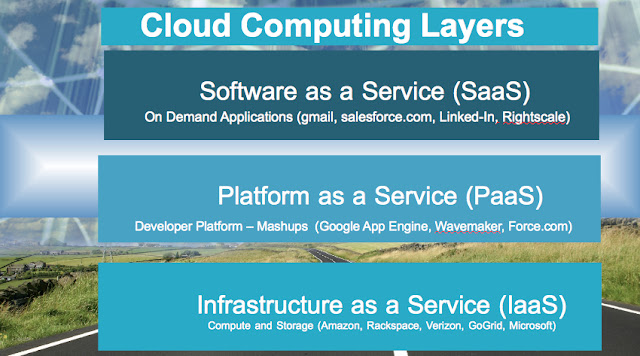


PaaS or Platform as a Service and IaaS or Infrastructure as a Service are two other considerations for manufacturers. PaaS and IaaS are for companies that are developing their own software. PaaS provides components that allow developers to combine these components or “mash up” to create new applications. IaaS provides the ability to create virtual machine images (VMI) and run these VMIs in the cloud. All software companies should absolutely be investigating SaaS, PaaS and IaaS.

What are the three things you should be asking your software vendors about cloud computing and specifically SaaS?

  1. Do you have a cloud version of your software? If they do, you need to understand all the pricing options. You should also understand the ability to migrate from a cloud version to a standard software version in the future if you choose to.
  2. Security, security, security. You must understand all the issues here.
  3. Performance and availability. Get it in writing and understand the issues.

Cloud computing is a game changer and you should absolutely be investigating it whether you are a small manufacturing shop or a large, global manufacturer. If you are a software company in manufacturing, then you don’t have a minute to waste before investigating cloud computing because your customers will be demanding it and it is the logical next step in your product roadmap. But, as with any technology, you must be able to separate the quality cloud providers from the disreputable cloud providers.

Dave Edstrom is the director for the Office of Strategic Innovation, AMT – The Association For Manufacturing Technology. For more information on cloud computing, visit his blog at: Photons and Electrons

Friday, December 10, 2010

Republicans Block 9/11 Firefighters Healthcare Bill

Here is the link to the article below.

"WASHINGTON — Republican senators blocked Democratic legislation on Thursday that sought to provide medical care to rescue workers and others who became ill as a result of breathing in toxic fumes, dust and smoke at the site of the World Trade Center attack in 2001.

---snipped---


"Republicans have been raising concerns about how to pay for the $7.4 billion measure, while Democrats, led by Senator Kirsten E. Gillibrand of New York, have argued that there was a moral obligation to assist those who put their lives at risk during rescue and cleanup operations at ground zero."

Let me see if I have this right.  The Republicans DON'T WANT TO PAY FOR THE TAX CUTS FOR MILLIONAIRES AND BILLIONAIRES BUT INSIST WE PAY FOR BILL THAT TAKES CARE OF THE BRAVE NY FIREFIGHTERS WHO BECAME ILL AT THE WTC DURING 9/11?


Go watch the GREAT job Jon Stewart did dedicating an entire Daily Show to the First Responders and the Republicans who are blocking this bill.  It is heart breaking to watch these four heroes below discuss the health problems they have because of 9/11.


The Daily Show With Jon StewartMon - Thurs 11p / 10c
9/11 First Responders React to the Senate Filibuster
www.thedailyshow.com
Daily Show Full EpisodesPolitical Humor & Satire Blog</a>The Daily Show on Facebook


I am sorry, there is politics and then there is just morally wrong BS political, posturing decisions and this is one of them....

Thursday, December 9, 2010

Redefining the Three D's in Manufacturing - IMTS Insider For December

This is an article I wrote for the IMTS Insider this month:

A statement made by John Engler, the president and CEO of the National Association of Manufacturers, keeps echoing in my mind. Mr. Engler, speaking at the Emerging Technology Center at IMTS 2010, said: “too often, people think of manufacturing as 3D – dark, dreary and depressing. How many of you recommended that your children should go into manufacturing?”

I think a lot about what Mr. Engler said that morning. After going on to discuss the exciting and cool aspects of manufacturing, Mr. Engler emphasized that the problem is the classic “perception is reality.” I could not agree more. I hear industry leaders in manufacturing bemoan the fact that there are very few young people who are entering manufacturing – even in today's economy. The question then becomes three-fold:

  • Can the “3D” perception of manufacturing change?
  • What is really needed to drive the change?
  • What specifically needs to happen for young people to think manufacturing is exciting, cool, pays well and has a very bright future?
  • Not easy questions, to be sure.

My personal opinion is that we are going to see a transition from Mr. Engler's 3D to a new 3D in manufacturing: Dynamic, Digital, and Disruptive
.   If you think that I am just coming up with marketing mumbo-jumbo, please keep reading. Let me be clear, it won't be marketing that will drive this change. It won't be President Obama visiting a manufacturing plant — although I am glad that the President is doing more for manufacturing than any president that I can remember.

Let's face it, if the United States had let the auto industry die out, it would have been a disaster for our country. A point the president also understands is the importance of the entire manufacturing process from design to distribution and the slippery slope that occurs when manufacturing leaves a country — so many other aspects of manufacturing eventually follow. The President’s emphasis on the entire art-to-part value chain seems to be a channeling of Doug Woods and AMT's Manufacturing Mandate. Driving down the price of additive technology, in the exact same fashion as the advent of the PC, will be the key. Let's take a look back to see the similarities to the PC industry.

I first started working in the computer industry in 1978. In the 1970s and early 1980s it was fascinating to witness the entire PC revolution unfold, from the introduction of the MITS Altair 8800 in 1975, Heathkit, Radio Shack's TRS-80, Apple-1, Commodore PET, the Atari and of course the establishment of the personal computer with the IBM PC on August 12, 1981. It is important to remember who had access to computers prior to the introduction of these small, reasonably priced units. Unless you or someone you knew was in the computer industry or you were attending college and majoring in data processing (that is what it was called before becoming known as computer science, or information technology), you had zero chance of ever getting your hands on a computer. The introduction of low-cost computing for the masses was the foundation for the greatest generation of intellectual property and wealth this planet has ever seen.

In Malcolm Gladwell's book Outliers, Gladwell states, "In fact, researchers have settled on what they believe is the magic number for true expertise: 10,000 hours." Gladwell brings up example after example of young people who had the gift of access to technology and the passion to use it as those who ended up being the leaders of the computer revolution. Being smart was not the sole requirement, but instead it was those with easy access to technology, the passion to learn and experiment, as well as just plain hard work that was the difference in those who changed the world. It took 10,000 hours before those individuals were true experts.

I believe there is a better than even chance we will witness history repeat itself, to a lesser degree, with manufacturing for the masses. Let's think about the similarities. Does the average person have the ability to actually manufacture something today? Not unless they are either in manufacturing or know someone who is. Yes, some schools provide basic machine tools, but it is not like those are easy to access for the masses.

Without question, the most exciting part of IMTS 2010 was the Emerging Technology Center. It was additive technology and the micro/nano technology that had everyone shaking their heads in amazement. The key will be additive technology and specifically 3D printers. The price of additive technology continues to drop.

A great example of the start of this revolution is Maker Faire. Maker Faire is put on by MAKE Magazine. From Wikipedia: “Make (or MAKE) is an American quarterly magazine focused on DIY (Do It Yourself) and/or DIWO (Do It With Others) projects involving computers, electronics, robotics, metalworking, woodworking and other disciplines. The magazine is marketed to people who enjoy "making" things and features complex projects which can often be completed with cheap materials, including household items.” Another site to check out is Thingiverse.   Thingiverse has a number of inexpensive additive technology devices and some interesting projects.

Today, the state of this technology is in the equivalent to what was going on in the PC industry back in the mid 1970s. These technologies are viewed as cool stuff for the geeks who like to make DIY or DIWO. There are five pieces of the puzzle that are needed for this additive manufacturing revolution to come to fruition. Four of these are already happening to various degrees.

  • Free or inexpensive CAD/CAM software. We are already there.
  • Low-cost 3D printers. This is the key piece that is starting to happen today to various degrees.
  • Service Bureaus. The ability to easily send the CAD files to a local 3D printing service bureau that can make the part on a full production 3D printer. This is already happening today with Proto Cafe in Redwood City, Calif.
  • Large additive technology companies and machine tool companies that realize it is worth priming this pump because it serves their strategic interests.
  • Everything connected on the net. With MTConnect we are quickly adding manufacturing equipment to the enterprise. Manufacturing is the network.

A great example of why this is important at the professional level is in Greenville, S.C., with a company called ADEX Machining Technologies. What is extremely impressive about ADEX is the new position they created. Traditionally, you have CNC programmers and machinists, which are separate positions.   ADEX has created a hybrid role where employees must be accomplished CNC programmers and skilled machinists. ADEX employees have made it very clear that, by wearing both hats, it gives them the satisfaction of both designing parts and then actually creating the part.   ADEX has a tremendous challenge in finding employees who can meet this new hybrid role.

Looking back at the PC revolution, we know the first phase was the ability to provide cheap computing to the masses and the second phase was when these low-cost systems were all networked. The PC revolution was Dynamic, Digital, and it was very Disruptive to the status quo. The entrepreneurs who developed software on PCs and then eventually started their own companies sparked a revolution. Who will be the Bill Gates, the Steve Jobs, and the Scott McNealys of manufacturing? I will bet that it will be those young people with access to technology, the passion to learn and experiment as well as those who are just plain hard workers who will end up changing the world of manufacturing from old 3D to new 3D — Dynamic, Digital and Disruptive. I can't wait.


Dave Edstrom
Director, The Office of Strategic Innovation
AMT - The Association For Manufacturing Technology

Wednesday, December 8, 2010

The Day The Music Died

Thirty years ago John Lennon was murdered.   For the baby boomers like me, December 8th, 1980 was the day the music died.  There would never a Beatles reunion and never be another John Lennon song or interview.   I mention interview because John Lennon had the courage and intelligence to speak on topics of the day.

Yoko Ono wrote yesterday in the New York Times:

"The most important gift we received from him was not words, but deeds. He believed in Truth, and had dared to speak up. We all knew that he upset certain powerful people with it. But that was John. He couldn’t have been any other way. If he were here now, I think he would still be shouting the truth. Without the truth, there would be no way to achieve world peace."

Of course John Lennon was a musical genius, but The Beatles also worked extremely hard.   In Malcolm Gladwell's book Outliers, Gladwell's premise is that it takes 10,000 hours of practice to become an expert in anything.  In the book, Gladwell discusses how The Beatles were invited to play in Hamburg, Germany in 1960 when they were still a struggling band.  What was unusual about Hamburg is that they had to play all night, eight hours straight, seven days a week, for weeks on end.   John Lennon, in an interview after the Beatles disbanded, talking about the band’s performances at Hamburg, said: “We got better and got more confidence.  We couldn’t help it with all the experience playing all night long. . . In Liverpool, we’d only ever done one-hour sessions, and we just used to do our best numbers, the same ones, at every one.   In Hamburg we had to play for eight hours, so we really had to find a new way of playing.”

Sunday, December 5, 2010

The Best/Worse Analysis Formula

Dr. Ben Carson (Dr. Don Long's protege at Johns Hopkins) looks at problems the same way my wife and I always have - a simple, but logical approach. 

  Below is from Ben Carson's book "Take The Risk":

The Best/Worse Analysis Formula

Whether it is deciding on career moves, knowing whether to accept speaking engagements, or discerning which cases to accept, I analyze the risk.

How do I analyze risks and arrive at a decision?

I use a formula that I designed called the Best/Worst Analysis (B/WA) formula. It is actually quite simple.

  • What is the best thing that can happen if I do this?
  • What is the worst thing that can happen if I do this?
  • What is the best thing that can happen if I don’t do it?
  • What is the worst thing that can happen if I don’t do it?

Saturday, December 4, 2010

Sun Old TImers Get Together -- C6 and C5


Above is John Meyer of IBM's red C6 with the IBM Power 8 processor tribute.  John used to be Sun's Mr. SPARC, so that was a big deal when IBM hired John away from Oracle.   Next to John's new Corvette  is my 98 C5 with the C5 and Spinal Tap reference.  Even though mine is 12 years older than John's, it still in pretty good shape :-)  We had a great get together this past Thursday at Gordon Biersch.  It is always fantastic to see all the Sun folks and find out how everyone is doing.  There will never, ever be another place to work like Sun Microsystems....

Cloud Computing Videos For Manufacturing

Below are three videos that will help those in manufacturing understand the basics of cloud computing.  These three videos were created at AMT - The Association For Manufacturing Technology.  These are very professional videos for one reason and one reason only - THE GREAT VIDEO EDITING WORK OF DIYANA HRZIC!
 
Cloud Computing Videos I, II and III

Cloud Computing Video I of III

Cloud Computing Video II of III

Cloud Computing Video III of III

Below are Cloud Computing Videos I, II and III


Friday, December 3, 2010

Tax Cuts - A Rising Tide Lifts All Yachts - Warren Buffet

Go watch This Week With Christane Amanpour when she speaks with Warren Buffett, Bill and Melinda Gates as well as Ted Turner.  That show is what sparked this blog post.

When I hear this nonsense about "trickle down economics" I go back to George H.W. Bush's statement to Ronald Reagan when he said that "trickle down economics" are "voodoo economics" and they are.  There is no Trickle Down Theory of Economics.  Period.   When I hear the Republicans talk about the need to pay for unemployment benefits but there is NO need to pay for the tax cuts for the ultra-rich it is crystal clear that they are either lying and/or stupid.  There are no other options - lying and/or stupid.  Do the math.  When you extend unemployment benefits to it goes right back into the economy.  When you give huge tax breaks to the rich, they keep it.  The myth of the rich pouring it back into the economy is exactly that - a myth.  CBO has also stated this in no uncertain terms as well.

If President Obama caves in to the Republicans on extending the upper two percent George Bush Tax Cuts then he will be the George McFly of politicians (great article explaining why Obama already is George McFly).  Politifact does a great job showing how completely out to lunch some of the key Republicans are on this issue.  It is no surprise, because any party (not all, but most) that is anti-science (think evolution, global warming, gays in the military, ...), would surely be anti-economics as well.  However, I do think the Republicans are brilliant in their ability to get Obama to cave on important issues.  Obama has zero courage and the Republicans have little knowledge of sciences and even less desire to help the country as witnessed by the Republican Senate Leader Mitch McConnell's "one term Obama" mandate.  Congress's inability or desire to make hard decisions is why we stay in the crapper right now as a nation.  I better stop now and stick to the point of my post - which is economic theory.  Hopefully my long term friend, Steve Fritzinger, will post his comments on this as he is a real expert on economics among other topics.  Steve has a podcast on economics for the BBC which is fantastic.

Obama will end up being a one term President.  As the old saying goes, "dance with who brung ya".  Obama's total cowardice when dealing with the republicans is just unbelievable.  He caves before any fight.  If he was a poker player, he would fold BEFORE the other players bluff.   When I read the following in Mother Jones Magazine, that came out in this latest Wikileaks fiasco (BTW, the founder of Wikileaks should go to jail for this) it became crystal clear to me that any hope of Obama having the courage to lead this country is completely gone:

"In its first months in office, the Obama administration sought to protect Bush administration officials facing criminal investigation overseas for their involvement in establishing policies the that governed interrogations of detained terrorist suspects. A "confidential" April 17, 2009, cable sent from the US embassy in Madrid to the State Department—one of the 251,287 cables obtained by WikiLeaks—details how the Obama administration, working with Republicans, leaned on Spain to derail this potential prosecution.

The previous month, a Spanish human rights group called the Association for the Dignity of Spanish Prisoners had requested that Spain's National Court indict six former Bush officials for, as the cable describes it, "creating a legal framework that allegedly permitted torture." The six were former Attorney General Alberto Gonzales; David Addington, former chief of staff and legal adviser to Vice President Dick Cheney; William Haynes, the Pentagon's former general counsel; Douglas Feith, former undersecretary of defense for policy; Jay Bybee, former head of the Justice Department's Office of Legal Counsel; and John Yoo, a former official in the Office of Legal Counsel. The human rights group contended that Spain had a duty to open an investigation under the nation's "universal jurisdiction" law, which permits its legal system to prosecute overseas human rights crimes involving Spanish citizens and residents. Five Guantanamo detainees, the group maintained, fit that criteria."

It is a shame that Obama looked like such a tough leader in the campaign and has turned out to be such a wimp when dealing with the republicans.

We have gone from the worst president of all time in George W. Bush to someone who looks like the cowardly lion in the movie The Wizard of Oz.

BTW, I am not a Democrat or a Republican, I am a pro-science, pro-logic, pro-knowledge, Independent and I recommend everyone watch The Daily Show or The Colbert Report to get their news and stay away from Fixed Noise (Fox News - it is clear why Fox hosts want Bush tax cuts extended) and MSNBC.  You will be better informed and a happier carbon based unit as well :-)

I should go back to writing about technology, it does not raise my blood pressure :-)

Thursday, December 2, 2010

Great Control Design Article

Below are the first couple of paragraphs on a great article written by Jim Montague, Executive Editor for Control Design.

"Hey, Mr. Machine, how're you feeling today? Mr. COO wants to know. Seriously?

Well, it's about time.

Operators, engineers and managers always want to know how well their machines are running. When machines were simple and shops were small, this was pretty easy to do. However, as machines and their corporations and staffs grew larger and more complex, it became harder to stay aware of how an individual machine's operational health could affect its company's economic health. You know, the old right hand doesn't know what the left hand is doing. 

Still, many sophisticated devices have been developed and implemented to check on the health of machine and production lines, and as these increasingly software-based tools pushed for more and better operations, they also opened up new levels of proactive and predictive maintenance. Likewise, enterprise resource management (ERP) software and other business-level tools also have grown more sophisticated. However, the persistent problem is that both the production and business sides and their monitoring tools apparently still don't know how to talk to each other. "

The bold text above is where the real win with MTConnect will come into play.  It is not just the monitoring, it is the integration of machine tools with rest of the enterprise where we will see the phenomenal changes in manufacturing.


Mr. Montague brings out that point here:

"Despite the historical drawbacks and other new hurdles, some machine builders are finding ways to get machine performance data up to their business-level managers and clients. One of the newest ways to secure and distribute machine information is with the MTConnect (www.mtconnect.org) standard that puts data from different types of equipment and applications into a standard format. Based on XML and HTTP, MTConnect fosters interoperability between machines, controls, equipment and software by employing a standard vocabulary to gather, publish and distribute machine tool data via Internet Protocol (IP) and Ethernet TCP/IP networking."

The rest of this great article is here....

Wednesday, December 1, 2010

MTConnect in the Market by Mark Albert

Mark Albert is the editor of Modern Machine Shop Magazine and wrote the most important article on MTConnect a year ago titled:  MTConnect Is For Real.   He wrote another great article titled, MTConnect in the Market.  Below is just a snippet from Mark's article:
"The developers of the standard, now operating as the MTConnect Institute, a not-for-profit, independent organization (mtconnect.org), were careful to avoid restrictions that might hinder its adoption on a voluntary basis. For that matter, there is no restriction on how products “powered by MTConnect” can be made available to the marketplace. In fact, a number of suppliers and end users have chosen to share developments based on MTConnect for free. That’s because they think promoting the standard this way is in their best interest."
Mark Albert is one of the best writers in the business and it is always great when he writes about MTConnect.

Tuesday, November 30, 2010

Tim Edstrom's National Honor Society Ceremony

Congratulations to our youngest son, Tim Edstrom, for being selected to the National Honor Society (NHS).  He joins his two brothers, John and Michael, in being NHS members.   His parents are very proud.  Below is the NHS ceremony at Broad Run High School tonight.  Congratulations Tim!


Tim with his grandma and grandpa on the right with his mom on the left in this photo.


Tim and his good friend Caleb Adams.  Tim and Caleb played lots of basketball together including for the AAU Shox.  Caleb and Tim are the only Shox who made it to NHS.

Dr. David Dornfeld's "Drinking From A Fire Hose"


Dr. David Dornfeld, Professor of Mechanical Engineering; Director, Laboratory for Manufacturing and Sustainability at University of California, has written two excellent articles:


                Drinking From A Fire Hose
                Drinking From A Fire Hose: Data Collection  Part II


Below is a great example of Dr. Dornfeld quantifying energy values in a medium facility:
"Recall that we had estimated that sampling energy data values for a “medium sized facility” for a day (here meaning 25 CNC machines, 10 programmable logic controlled machines and assorted other handling and line equipment with 8 data sources per machine at a sample rate of 5 hertz) would yield a data stream of 86,400,000 data points each day. And that if we added the other sources, we’d likely end up with 100 million data values a day to deal with.
Below Dr. Dornfeld discusses the importance of correlation:

So, let’s continue our discussion from last time. Data can be related to events and information associated with those events. Thus, data can be understood as something that occurred either at a specific time or over a range of time. In manufacturing systems, events can be a numerical value (for example, the instantaneous power consumption at a specific time) or can be a type of annotation (for example, the alarm state of the machine tool over an interval). Complex events are abstractions of events that are created by combining simple events. For example, based on simple events pertaining to the tool position, the instantaneous power consumption, and the machine tool’s program in machining a part, we can create maps linking power and stages of part production"
Dr. Dornfeld is an internationally known expert and one of the creators of the MTConnect protocol as well.  Dr. Dornfeld is also known for Dornfeld's Law.

Monday, November 29, 2010

Cloud Computing - HMI as a SaaS

There was an interesting post on LinkedIn regarding HMI as a SaaS called GoToMyHMI is Your 'HMI-Gateway' in the Cloud for HMI Access from Any Device, Any Where

I do not have any specific experience or knowledge with this product by Software Horizons.  The reason I think this is interesting is that it appears to be a very nice example of manufacturing using the cloud to provide a valuable service.

Sunday, November 28, 2010

Scaling TSA Does Not Equal Follow Israel's Example

When I hear that TSA should follow Israel's security practices, I think of Mike O'Dell's timeless advice:

Scaling is ALWAYS the problem.

Israel has 20 flights per day.  The US has 20,000 flights per day.  Do the math.  Dana Milbank did today in the Washington Post:

"In a time-consuming and labor-intensive process, Israel uses profiling, background checks and extensive interviews to filter out the highest-risk fliers, who are then subjected to searches of luggage and person more invasive than anything the Transportation Security Administration has conjured. The air security argument has been about whether Americans would prefer Israeli-style profiling to the current system of body scans and pat-downs. But this overlooks a more fundamental problem: The Israeli system, even if it could be scaled up, is out of our price range. 

El Al, Israel's national carrier, reported spending $107,828,000 on security in 2009 for the 1.9 million passengers it carried. That works out to about $56.75 per passenger. The United States, by contrast, spent $5.33 billion on aviation security in fiscal 2010, and the air travel system handled 769.6 million passengers in 2009 (a low year), according to the Bureau of Transportation Statistics. That amounts to $6.93 per passenger."
clear pixel

We are not even having the right conversations on airport security and we never will as long as Congress has anything to do with it - and they always will....

Nice MAG Freedom eWare Article at Automation World

A sign of maturing standard is when it is simply referenced in an article, such as this one on eWare at Automation World, where it states:

"The software, which is MTConnect compliant, can interact with smart phones, tablet PCs and similar mobile devices, displaying machinery status, productivity data and machinery analytics for various systems on a plant network"

Saturday, November 27, 2010

Virtualization.net

It is interesting to see what trade rags pick up either an article or a video.  Virtualization.net picked up a video that I created with Diyana Hrzic's brilliant editing on cloud computing that was only sent to those individuals who attended the Emerging Technology Center (ETC) at IMTS 2010.

Virtualization.net looks like a very interesting site that has a wealth of cloud and virtualizaton information.

Empty Clouds


I have written a number of articles and white papers on cloud computing.   I always emphasize security as job #1.  While there are many, many advantages to cloud computing, there is one area that some SaaS providers are taking the easy way out - Service Level Agreements (SLAs)   I have stated in every one of my articles and presentations that SLAs in a written agreement are critical before you place a cloud bet.  I can not over emphasize how important it is to have a viable and written SLA.    Look at the big dog in the IaaS room, Amazon's EC2, and you will see a company that has seriously thought about this and provides a reasonable degree of assurance and protection when you are placing a business bet on the cloud.  A number of software companies still do not get it that you simply can not expect a business to place a huge bet on your SaaS when there is no recourse if that service is down.  We hear stories all the time from software sales reps that state, "you can get an SLA if you really push it and are a big customer."  You should not have to be a big company to get an SLA.

Prior to SaaS, I did a great deal of work with High Availability (HA) servers at Sun Microsystems with Sun's partners (in the early 1990s) and Sun's software.  The challenge with HA servers was multiple from asymmetric to symmetric HA servers, to round robin load balancing, to eliminating Single Points Of Failures (SPOFs), to HA aware software, to upgrades, to patches, to version control, to sysadmin, to a thousand other issues.   Running your own HA servers was a non-trivial task to take on.  SaaS, in theory, should eliminate most of these concerns as the SaaS provider takes on the hard computer science challenges.  This does not mean that you don't question your SaaS provider regarding how they take care of these issues behind the scenes.  If you do, you will be treating your SaaS provider just like the Wizard behind the curtain in the movie - The Wizard Of Oz.  Remember the old phrase, "if you assume, you make an a$$ out of you and me."


It is simply a matter of time before we start hearing of customers openly demanding that SaaS companies step up to the plate as Amazon and others have to provide meaningful SLAs. The SLAs are now becoming more of a standard for IaaS and will be for PaaS.

What is an empty cloud?  A SaaS with no SLA or a completely vague SLA that provides ZERO recourse.  The industry is going through a learning phase right now.  Companies are going to realize that you simply must have an SLA.   There is another option if the SaaS company refused to have an SLA and that is a disaster recovery (DR) option that can be either hot or cold started in the event the service is down.   If you can get a copy of your data and get a perpetual license that you can run either locally or in another cloud instantiation, then get a DR as an option.  Clearly, this option may not be possible for many, put it is available for some.  

Lenny Rachitsky at Transparent Uptime has a GREAT post on the importance of SaaS Dashboards that is a must read.  Below are five areas he brings out in his post:
 "Lets first define what makes an online health dashboard "successful", and in the process explain why you (as a SaaS provider) should have one:
  1. Your support costs go down as your users are able to self-identify system wide problems without calling or emailing your support department. Users will no longer have to guess whether their issues are local or global, and can more quickly get to the root of the problem before complaining to you.
  2. You are better able to communicate with your users during downtime events, taking advantage of the broadcast nature of the Internet versus the one-to-one nature of email and the phone. You spend less time communicating the same thing over and over and more time resolving the issue.
  3. You create a single and obvious place for your users to come to when they are experiencing downtime. You save your users' time currently spent searching forums, Twitter, or your blog.
  4. Trust is the cornerstone of successful SaaS adoption. Your customers are betting their business and their livelihoods on your service or platform. Both current and prospective customers require confidence in your service. Both need to know they won't be left in the dark, alone and uninformed, when you run into trouble. Real time insight into unexpected events is the best way to build this trust. Keeping them in the dark and alone is no longer an option.
  5. It's only a matter of time before every serious SaaS provider will be offering a public health dashboard. Your users will demand it."
Bottom line: Do NOT go for a a SaaS with zero SLA or at least a Disaster Recovery Cold/Hot Start Server or you will be sorry.

Thursday, November 25, 2010

Happy Thanksgiving To Our Troops

Happy Thanksgiving to all of our troops who are serving in harms way this Thanksgiving.  It is nice to see the various sporting events honor the troops today.

Sunday, November 21, 2010

MTConnect Sub-Module


As President and Chairman of the Board for the MTConnect Institute, I am very pleased to announced the first addition to the MTConnect family of logos - MTConnect Sub-Module. A sure sign of success for any protocol is when companies or organizations come with new and creative ways to implement a protocol.  This is the case with MTConnect Sub-Module.  MTConnect Sub-Module is to be used to recognize or label the hardware or software segment that provides a part of the MTConnect protocol that sits in a TOTAL MTConnect solution.   In other words, the solution MUST provide a TOTAL MTConnect solution, but a member MUST label those parts of those solutions that are simply sub-modules that depend on other modules for a complete solution.

An example is in order here.    GE/Fanuc created a COMPLETE MTConnect black box solution in 2008 (note this is no longer available after the two companies went their separate ways) that was the size of a brick that had everything you needed in one box to connect an existing machine tool to the outside world.  On one side of the brick were your legacy ports for machine tools.  On the other side of the box were four ethernet ports that all supported the FULL MTConnect protocol ie adapter/agent.  The box ran Linux with all of the necessary MTConnect software.  All you needed was a client someplace on the net.  Now imagine if GE/Fanuc had decided to make that solution into two separate boxes to accomplish the same thing as the single box.  Imagine that those boxes required each other in order to provide a complete MTConnect adapter/agent.  In that scenario, each of those boxes would be an MTConnect Sub-Module and together they would be MTConnect compliant.

Friday, November 19, 2010

Cloud Computing For Manufacturing Intro Video Part 1

Below is a cloud computing video  that helps those in manufacturing understand the basics.  This is one of three videos that we created here at AMT - The Association For Manufacturing Technology.  This is a very professional video for one reason and one reason only - THE GREAT VIDEO EDITING WORK OF DIYANA HRZIC!


Cloud Computing For Manufacturing Intro Video Part 1

Thursday, November 18, 2010

[In]Decision Points

I would be remiss if I did not talk about President George W. Bush's memoir Decision Points.  So, what prompted me to write this?  Bush's book that was released?   Not directly.  What prompted this was my father telling me of the young soldier that was in the chemo room with him this week at Walter Reed Army Hospital on the Oncology Ward that was missing both legs, both arms and was receiving chemotherapy with his young wife watching.  My first words out my mouth were, "Jesus Christ!"  My next words can not be uttered here, but this posting will provide the facts that lead to that comment.

If you believe George W. Bush should be the fifth entry on Mount Rushmore, then you might want to stop reading now.

Let's see, where to begin....
  • First, I always have said that George W. Bush  would be a great neighbor.  Easy going, does not seem to be an in your face type of guy.  When he was drinking, he was probably a very funny guy to hang out with as well :-)
  • Second, I always thought his dad had both brains and guts.
  • As a president, however, George W.  Bush will absolutely go down as the worst ever.
    • Three unfunded tax cuts that were mostly for the rich.
    • Two unfunded wars.
      • Bush later admitted that Iraq had NOT A DAMN THING TO DO WITH 9/11.
      • Thomas Friedman's "Too Good To Check" column on the "Obama's Asian visit costs $200M/day" nasty rumor, as trumpeted by FN.  The list price for the Afghan war is $190M/day and Iraq is $2BILLION/week, not counting the tragic fallout facing soldiers at Walter Reed.  (Put another way, we could just pay 30M Iraqis $67 a week to like us.)
      • When talking about the cost of Bush’s wars, we usually count the dollars and American troops killed/maimed.  That leaves out two huge groups: 
        • Iraqis/Afghans whose lives have been destroyed and contractors.  In Iraq several hundred thousand Iraqis have been killed out-right by violence and 1 to 1 ½ million have died from other war related causes like disease.  Another 3 million have been turned into refugees.  We should NOT leave them out when counting costs, but I am sure some will view this as just "collateral damage".
      • There are also at least as many contractors, many from poor nations just looking for any job, as there are American troops in Iraq and Afghanistan.  They get killed and maimed just as frequently as our troops, but we never even bother to count them either.
    • An unfunded Medicare prescription drug program
    • Making regulation a four letter word.  The Great Financial Recession happened on Bush's eight year watch.  
    • We are talking trillions of $$$$$$$$$$$  here folks....
  • Let's see, how did that work out?
    • Let's remember Bush inherited a surplus.
    • Bush watched the national debt grow from $5.6 trillion to nearly $10 trillion
    • "You see, the growing surplus exists because taxes are too high, and government is charging more than it needs," Bush said in February 2001.     Uhhhh, that would be a big no.  Not when you are in the hole as a country.  Driving down the debt was a smart thing.
      • We are in such a huge financial hole right now because of Bush's idiotic decisions.  Congress will not have the courage to do what other countries are starting to do - make the hard decisions no matter how unpopular they may be.
    • For those longing for Reagan, go back and look at the numbers here at PresidentialDebt.org
      • Looking at those numbers, you realize that Reagan was much worse on the debt, but that is not the point of this blog entry :-)
  • When I hear Bush state, "I kept America safe."  WHAT!  Bush likes to forget that 9/11 occurred on his watch.  We need only go back to the famous seven minutes of Bush sitting there wide eyed listening to the teacher in Florida reading "My Pet Goat" to realize that this guy had not a clue on what it takes to be a great president.
  • Obama was given one hell of a mess.  Obama needs to spend more time doing what is right and less time answering questions that appear on Fixed Noise and the other wacko "news" outlets.  Yes, MSNBC can be just as wacko, but it does not have the money and power that Fixed Noise does.  If Obama continues to kick the can down the road and show no courage in standing up to The Party of No, then he will be a one term president as well.  Democrats have zero guts.  
  • What I can say that I admire about Bush is that he has kept his mouth shut since he got out (except for this book). That takes restraint and class.  He should tell his buddy Cheney to exercise some class as well.

Tuesday, November 16, 2010

Rodney Dangerfield and American Manufacturing


Below is an article I wrote for the IMTS Insider.


Rodney Dangerfield and American Manufacturing


Twenty-one percent of everything made in the world is made in the United States of America.  China makes 12%. Surprised? Probably not, if you are reading the IMTS Insider, because likely that means you are in manufacturing.  However, I bet if you asked individuals outside the industry which country leads the world in manufacturing, their answer would likely be China.  You then might get into a long discussion about the price of labor and politics. But that is not the point of this article. This article was sparked by a recent NPR Planet Money podcast called The Friday Podcast: Buttons And Other Connectors.
I would encourage everyone to listen to this short podcast because it drives home a very simple point that is sometimes forgotten in manufacturing; it is NOT lean manufacturing, it is innovative technology. Don't get me wrong, the principles of lean are important, but if you are not innovating, being lean is simply a race to the bottom. How much do you spend on R&D? It always blows my mind when I hear someone in manufacturing say that there is not a lot to be gained by investing in R&D. 
The podcast compares and contrasts two companies.  As NPR states on their Planet Money home page:
“Back in the day, the Buttonwood Corporation ran double shifts at its New York City factory, with 150 machines cranking out tens of thousands of buttons.  These days, Chinese factories not only have cheaper labor, but also newer, fancier machines. Buttonwood — a family business, owned by two brothers — has just one employee left. They sell small orders of wood buttons, and take orders online at woodbuttons.com.
The Zierick Manufacturing Corporation makes products that are all around us, but we never notice: little pieces of metal that connect electronics components to control panels.  This sounds like the kind of cheap commodity item that would be made in China. But it isn't; Zierick's factory is in upstate New York. Zierick's trick is to keep coming up with new, patentable ideas to make connectors better and better. So if you want a really good, reliable connector, it's worth it to pay more and get one from them. The company's doing well.They have lots of employees, lots of customers. They just have to keep coming up with new ideas to stay ahead of everybody else.”
Why do I have Rodney Dangerfield in my title?  The companies that are innovating and growing do not get the respect they deserve because most people believe “American manufacturing is dead.”  In today's sound bite news world, this is not surprising. Tell your non-manufacturing friends who is winning and why in manufacturing.  Finally, when you listen to this podcast, you can see the difference between someone who is looking forward and innovating and someone who is looking at years gone by.  Sometimes you are the windshield and sometimes you're the bug.  Innovate and be the windshield: It’s much better that way.
Dave Edstrom
Director, The Office of Strategic Innovation 
AMT - The Association For Manufacturing Technology