Thursday, September 26, 2013
The Amazing Engineer Richi Parker of Hendrick Motorsports
This is an incredible video of a very talented engineer at Hendrick Motorsports. His name is Richi Parker.


Wednesday, September 25, 2013
Great MTConnect Article by Leslie Langnau - Tips on Working with the MTConnect Industrial Network
Leslie Langnau, Managing Editor for Design World, wrote a great article on MTConnect titled - Tips on Working with the MTConnect Industrial Network.
This is one of the best articles that I have seen written on MTConnect.
Leslie presents the beginning accurately.
Go check out this extremely well written article by Leslie Langnau - Tips on Working with the MTConnect Industrial Network!
This is one of the best articles that I have seen written on MTConnect.
Leslie presents the beginning accurately.
"At the 2006 annual meeting of The Association for Manufacturing Technology (AMT), presentations from David Edstrom of Sun Microsystems and Dr. David Patterson, Professor of Computer Science at the University of California, Berkeley described the need for an open communication standard that would allow manufacturing equipment to connect to the Internet and use it as a means of data exchange. The question asked was, how could manufacturing replicate the IT model of interconnectability? By 2008, joint efforts among academia and industry machine developers resulted in the MTConnect protocol, an open, royalty-free communication standard that uses Internet communications technology to link machines and systems together. The protocol is based on HTTP and XML."Leslie does a very thorough and professional job laying out the different ways to communicate to manufacturing equipment, the types of data that can be captured, specifics on the protocol itself, as well as providing very well thought instructions on how to proceed. Below is a snippet on how to proceed.
"Once you’ve established what MTConnect connection equipment or software you need, the next steps are:
- Clearly define your problem. Are you looking to improve production capacity? Is there an issue with excessive or unpredictable downtime? If you could see information more clearly, how would that benefit your bottom line?
- Determine how you will measure success. Will a successful MTConnect implementation be evaluated by improvements in production capacity; by what percentage, for example? What measurements and parameters will be used to evaluate the benefit of using this protocol?
- Determine the equipment that will need to be connected. What controls, sensors, measurement devices, and so on will need to be involved? It is important to know the details of all controllers involved.
- Define the limitations or constraints you may encounter, such as budget, accessibility, security issues, must-have functions, legacy network systems, and so on?
- Determine who will be in charge of the implementation process. Also assess which departments will benefit from more and better data. Who or what could restrain or even derail the project?
- Define the resources you will need to implement the project. What equipment will be sending data, what software will be needed, and what legacy network systems will you be working with?"
Go check out this extremely well written article by Leslie Langnau - Tips on Working with the MTConnect Industrial Network!
Tuesday, September 24, 2013
Happy 30th Wedding Anniversary to My Beautiful Bride
Today is our 30th wedding anniversary. We celebrated in Maui this summer and went out for dinner tonight. She is still absolutely beautiful!

Sunday, September 22, 2013
Now available on iTunes - MTConnect: To Measure Is To Know!
Now available on iTunes - MTConnect: To Measure Is To Know!

It is also available on Kindlex, Amazon for hard copy as well as on Google Play for Android!
The Absolute Easiest Way To Have PCs Use Printers That Are Connect To Macs via USB
After purchasing and connecting a new Samsung laser printer, I decided to move some of the USB connected printers to different locations where the Macs were located so the Macs would share the USB printers.
What should have been brain dead easy, was now an exercise in getting these low level authentication errors:
On HOLD:AUTHENTICATION REQUIRED
After googling around for the above text and seeing lots of complicated solutions or folks just ranting, I ran upon an off hand comment that got my attention.
The post was on getting printers to work for both Macs and PCs - no matter which direction and it went it to great detail on user security settings on both Windows and Mac OS X, but at the end of this long post, there was an off hand update that basically said, "unless you just want to use bonjour from Apple to do the same thing."
So, I googled around again and it turns out that this person was referring to:
Bonjour Print Services for Windows v2.0.2
As it says at Apple for the description:"Bonjour Print Services for Windows lets you discover and configure Bonjour-enabled printers from your Windows computer using the Bonjour Printer Wizard.
Use Windows Update to make sure you have the latest Service Pack installed for your computer.
Printer requirements
Bonjour Print Services works with either:
* network printers over Wi-Fi or Ethernet
* USB printers shared via a Mac or an AirPort base station"
This is ABSOLUTELY the way to go when you have your PCs easily talk to printers that are connected directly to a Mac. Of course, you need to remember to share the printers on the Mac side to everyone.
Saturday, September 14, 2013
Manufacturing Encryption
Manufacturing Encryption
By: Dave Edstrom
This month we are wrapping up my summer series on manufacturing cyber security by taking a deeper dive into what encryption is and how to think about its importance in manufacturing. Before we take the plunge, let’s see how we got here these past few months. We started earlier this summer from the 100,000 foot level with cyber security. We dropped down to 5,000 feet with a discussion on manufacturing passwords, and then we lowered the plane to 500 feet withmanufacturing authentication and authorization. Today we are taking the topic to the 100-foot level with a discussion of encryption.
There are three questions I am going to answer directly in this article as well as providing a quick summary of the manufacturing security articles this summer. What exactly is encryption? We are told to look for this lock anytime we are dealing with important information, but what is happening under the covers? How does this apply to the shop or plant floor?
Sending information securely is an old problem. How does someone send a message over a public medium with the guarantee that only the person who should be receiving it can read it? The classic example of this is in the military, but there are many examples where this is critically important in manufacturing as well. A military leader needs to be able to send commands to troops in the field, but the generals do not want that information intercepted by the enemy. A very important reason the Nazis lost World War II was because of the incredible work by the British at Bletchley Park when they were able to intercept and decode the Germans’ messages by understanding how the Enigma machine worked. It is widely believed that this might have taken two years off the length of World War II. Sending information is even more important today and not just for the military. GM might want to send the design for a new model of the Corvette Stingray to a supplier over the Internet, and GM certainly does not want that information shared with competitors or the press.
I mentioned previously in this series, but it is worth repeating. The way to think about security is first from the absolute highest level and then work your way down from there. The highest levels of security have to do with the nature of information in general such as data at rest and data in flight. Data at rest is information that is sitting on disk drives and should be encrypted. Data in flight refers to information that is being moved from one location to another and should also be encrypted. What exactly is encryption? It’s taking information and scrambling it with a key in such a way that only the intended recipient can read it with a key. The important and significant challenge is the complexity of these keys and the handling of these keys. This is really no different than locks on your house. Encryption means that the information is “scrambled” and is not readable, decrypted, without the appropriate key. The size of these keys and the encryption algorithm are just a couple of the decisions that must be made. Individuals earn Ph.Ds researching these topics alone.
Before we get a little more technical on manufacturing encryption, let’s take a quick look back on how we got here. In June, we started talking about cyber security. I mentioned that as manufacturing continues to embrace complete supply chain integration, cradle to grave digital thread tracking of parts, open and royalty-free standards such as MTConnect, as well as networking across the board, the importance of cyber security in manufacturing will continue to grow.
In July, we started talking about the fact that as manufacturing becomes more and more interconnected with the outside world, the need for security will increase exponentially. Security can be thought of as an onion with different layers that are needed for protection. A strong password for a user would be something along the lines of a!&tR)^-n8@#&y\B. That password is 16 characters in length and has a variety of characters to it. The obvious challenge with that type of password is that it is hard for us humans to remember. The trick is having a password that a human can remember and makes it difficult for computers to guess by having that mix of characters and a long password.
In August we discussed “Manufacturing Authentication and Authorization”. AIn that article, I used Peter Steiner’s classic New Yorker cartoon with the caption “on the Internet, nobody knows you're a dog.” This cartoon has one dog sitting on a chair and typing on a computer while speaking to a second dog sitting on the floor. It perfectly summarizes the problem with computer security. Specifically, how do you know the person is really who they say they are, and what exactly is that person allowed to do? In the world of security, this is called authentication and authorization, which are two of the key pillars upon which applications and data depend for safe operations.
Most people have a rough idea how encryption works, but let’s take a little bit more detailed look. Let’s say you are an MTInsight subscriber. For those who are not familiar with MTInsight, it’s a business intelligence (BI) tool based on three key elements: BI software, AMT's experience and analysis, and our unique data warehouse — all of the information AMT tracks on your markets, benchmarking surveys, industry forecasts, your competitors, customers and supply chain.
If you type MTInsight.org into your browser and you see the following:

There are a few things worth pointing out.
- A lock on the far left of the toolbar.
- You will notice that the when you typed in MTInsight.org that the text changed from black togreen and the complete name for AMT appeared. The purpose of the certificate is to insure that AMT is the owner of the site. This type of certificate is known as an EV or Extended Validation Certificate. EV Certificates require much greater business verification and validation on exactly which organization is the legal entity that owns this site than a standard certificate requires. When you see an EV Certificate it is a sign that the company takes security very seriously.
When you go to a website that has a lock, you can learn the specifics of the certificate clicking on the site’s name next to the lock. For example, this is what you would see for MTInsight.org:

We are told to look for this lock anytime we are dealing with important information, but what is happening below the covers? There are a number of steps, but we are going to keep this at a high level. MTInsight.org has two keys: A public key that anyone can see and private key that only MTInsight.org knows. A key is a very long number. What makes this public key and private key work is something called one-way function. A one-way function is a mathematical algorithm that can use a public key to encrypt data and the only way to decrypt it is with the private key. Even the entity that encrypts the data cannot decrypt it without the private key.
When MTInsight.org is entered into the browser toolbar, the first thing that happens is your browser verifies with the EV Certificate that MTInsight.org is the real MTInsight.org and not an imposter site. After that happens, your browser and MTInsight.org need to speak in a secure fashion. In order to do that, both sides must agree on a secret key. The question now becomes, how do they share a secret key?
- You type https://MTInsight.org into your toolbar.
- MTInsight.org sends its EV Certificate and its public key to your browser.
- Your browser verifies this is MTInsight.org is valid, then your browser uses MTConnect.org’s public key to send the secret shared key that both systems will use to securely communicate.
- MTConnect.org uses its private key to decrypt the message from your browser and then starts using the shared secret key for communication.
How does this apply to the shop or plant floor? Remember that both data at rest and data in flight should be encrypted. We covered lots of security information this summer. If I could leave you with just one message it would be Andy Grove of Intel’s timeless advice, “only the paranoid survive.” When it comes to manufacturing security, be very, very paranoid. It will serve you and your company well in the long run.
Friday, September 13, 2013
My Afternoon at Tesla Motors in San Mateo

Below is the huge info screen.


Above is the "instrument panel" that unlike any I have seen.


I went for a drive in the Tesla Model S P85 four door sedan. When I jumped on it it was 0 to 60 in 4.2 seconds, immediate torque and totally quiet. Very, very impressive.

Thursday, September 12, 2013
My Tour of PARC - The Legendary Palo Alto Research Center
On of my dreams came true yesterday when I was given a private tour of the legendary PARC - Palo Alto Research Center.


Here I am standing in front of the very famous photo of the early days of PARC.
The list of incredibly talented individuals and inventions are literally too numerous to list on a blog post. Here are just a tiny subset of the ground breaking inventions (as listed at PARC's homepage)
- the laser printer
- object-oriented computing
- the personal workstation
- ethernet
- distributed computing
- VLSI circuit design
- WORM
- natural language programming

On the right are some very early robots.

Above is the world's first laser printer.

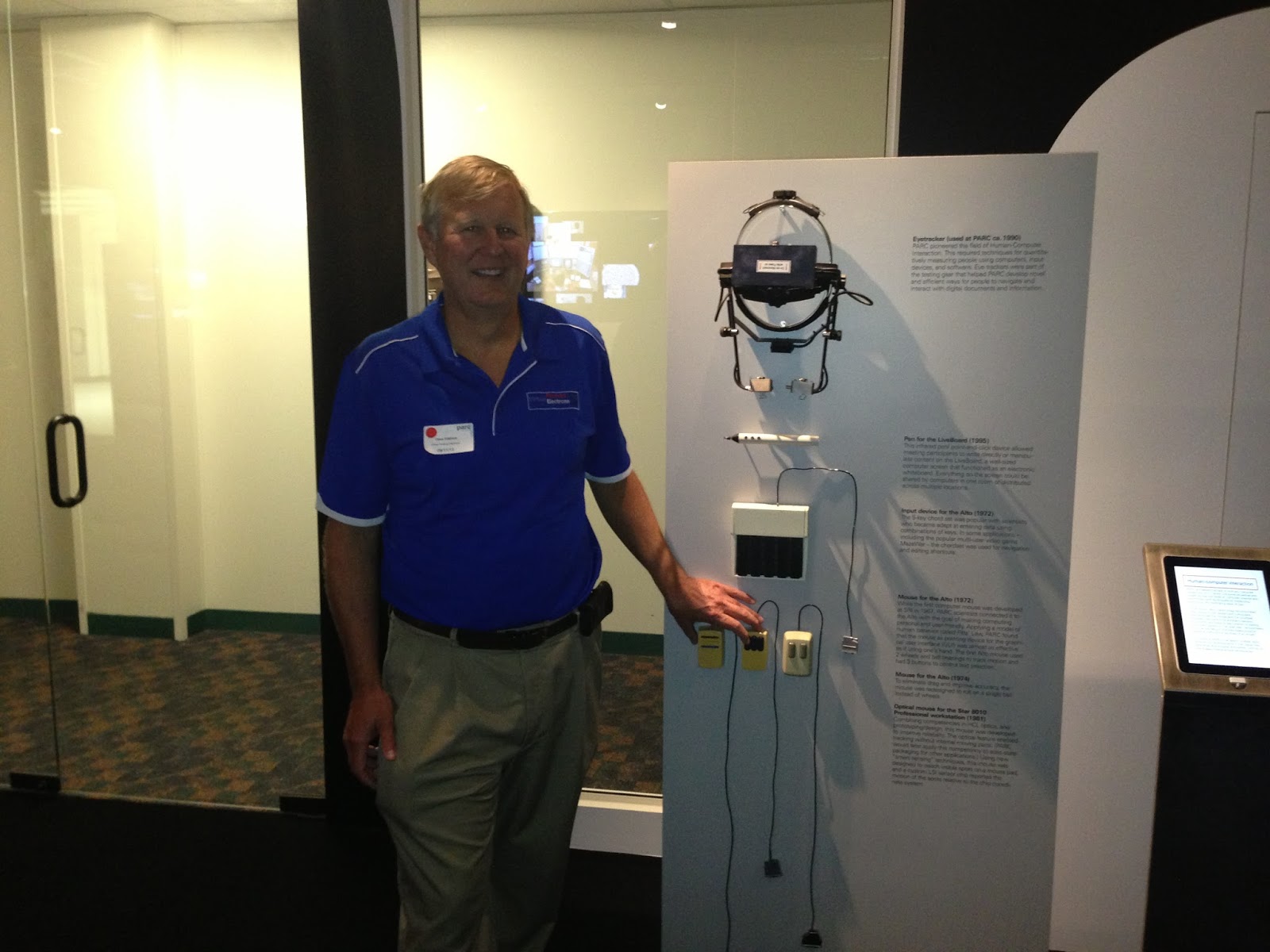
Above is me touching the world's first production mouse created by Douglas Englebart.
I remember being ten feet away from Steve Jobs at Sun event when he retold the famous December 1979 "Steve Jobs visits PARC and sees a GUI and a mouse for the first time."


Above is Bob Metcalfe's ethernet boxes that were invented at PARC and the first VOIP which was the 1982 etherphone that you see as well.

The next day, I thought as long as I visited the legendary PARX, I should at least swing by the legendary venture capitalist, Kleiner Perkins Caufield Byers on Sand Hill Road. On my way to Tesla, after having lunch with my oldest son John at Facebook, I had to swing by Khosla Ventures below.

Thursday, August 29, 2013
Kip Hanson's Cutting Tool Engineering's "Let's Chat" Article
Kip Hanson wrote a very interesting article for Cutting Tool Engineering that is titled "Let's Chat". Kip interviewed me and a number of others for this article.
Below are some snippets from the article:
"Dave Edstrom, president and chairman of the board at the MTConnect Institute, McLean, Va., said, “Our vision is to provide an easy way for people to get information out of their equipment at a greatly reduced cost.
It's a long and very well written article. Here is an example of just how real MTConnect is:At a 2006 meeting of AMT—The Association For Manufacturing Technology, Edstrom made a bold statement: The industry was 21 years behind the curve in terms of communication. “Everyone was talking smart machines this and smart machines that. So I told them, ‘Why don’t you guys just get the damn things [manufacturing equipment] to speak the same language!’ There was no reason to reinvent the wheel.”Edstrom explained that many new machine tools already had Ethernet on board or available as an option. HTTP and XML were well-established protocols by that time on the Web. Working with Dr. David Patterson of University of California-Berkeley, they convinced AMT that these communication standards had already worked for the computer industry for more than 2 decades—why not apply them to machine tools as well? Apparently, their speeches were convincing because AMT provided $1 million to develop MTConnect.Oh, great, you’re thinking, one more CNC interface to contend with, along with more programming, more complexity and more variables, while all you want to do is ship parts. Not so fast. Edstrom said: “MTConnect is not an interface, nor is it a programming language. It is a simple, royalty-free, open-source standard built upon proven protocols. Similar to browsing on the Internet, MTConnect lets you type in the name of a machine tool and receive back simple verbs, such as probe, current, sample and asset. You say ‘send me data on what you’re doing,’ and the control returns that data to a database, spreadsheet or software program.”
"Collaborating with MTConnect sponsor TechSolve Inc. in nearby Cincinnati, Itamco has worked for the past year on a project to connect everything in the shop to ShopViz, a central machine monitoring system. It’s about 25 percent complete.Aside from the aforementioned benefits of machine tool monitoring, Itamco has seen some surprising results. By tracking power consumption on its equipment, Itamco reduced its energy costs. Neidig said: “Our utility company charges a much higher rate if we exceed the base level during peak hours. Because we can now monitor that real-time, we found that we could schedule jobs based on that usage. We cut our electric bill—roughly 14 percent of our total operating expenses—by more than 30 percent.”
Wednesday, August 28, 2013
Manufacturing Media Engineering's Article on Shop Floor Monitoring
Patrick Waurzniak wrote another great article at Manufacturing Media Engineering titled, "Shop-Floor Monitoring Critical To Improving Factory Processes".
Below are a couple of snippets where Patrick spoke with me on this article.
Without shop-floor monitoring systems, manufacturers cannot effectively employ OEE metrics and lean manufacturing, said Dave Edstrom, president and chairman, MTConnect Institute (McLean, VA). At the MTConnect conference last April, the new MTConnect Challenge was presented, aiming to spur development of advanced manufacturing intelligence applications using the MTConnect standard. Edstrom said shop-floor monitoring is a must for both OEE and lean. “I think a lot of people are kidding themselves, because if you don’t have the data, you can’t be doing OEE or lean,” Edstrom said.snipped....
“The myth among machine tool builders is that it doesn’t benefit them, but when you talk to them, they’re differentiating themselves by being open, and it’s saving these machine tool builders direct money,” Edstrom said. Most builders supporting MTConnect have included agents and adapters for the protocol with newer machines for free, he added, or charge for a nominal fee on adapters for older legacy equipment."
Monday, August 26, 2013
Corvettes at Carlisle 2013
This was a very, very special Corvettes at Carlisle for a number of reasons:
- 60th anniversary of the first Corvette
- 50th anniversary of the first Corvette Stingray
- Announcement of the new C7 Corvette Stingray


Above is me with Kirk Bennion of GM who designed the Corvette Stingray! Kirk gave me a Stingray pin that is typically for Corvette team members who actually work at GM which I thought was very cool.

Above is me with Tadge Juechter of GM who is Chief Engineer for the Corvette Stingray! I spoke with Tadge for 15 minutes without any interruptions which is incredible amount of time with an industry legend.


Below is the C6R race car that has been kicking butt and taking names in the GT2 class and previously the GT1 class prior to 2009.


Sunday, August 25, 2013
SPARC at 25 Years - GREAT Panel of Computer Industry Legends
I watched this FANTASTIC panel on SPARC - Scalable Processor ARChitecture that had ALL of the Sun Founders - Scott McNealy, Vinod Khosla, Andy Bechtolsheim and Billy Joy as well as Dave Patterson of UCB and the first VP of Engineering Bernie Lacroute and Anant Argrawal who led the first SPARC processor design team and Rick Hetherington who was a microprocessor designer at Sun.
If you are a fan of Sun OR like computer processor architecture discussions this is worth an hour and half of your time.
I was at Sun prior to SPARC, so I remember how all of this came about from a field standpoint. At the time, the hot chip was a 25MHz Motorola 68020 that was 4 MIPS. When the first SPARC chip came out, it was 10 MIPS, 16MHz and was manufactured by Fujitsu and was on a pair of 20,000 gate array. It was codenamed Sunrise. The first system was a SPARC 4/260 which was a desk side system. What I remember about the introduction of SPARC was they wanted to have SPARC Ambassadors out in the field. At the first meeting, Sun's microprocessor engineering team wanted us to demonstrate the advantages of SPARC by showing how SPARC register windows worked with this round piece of paper that had these windows cut in them and you rotated the paper around to show how the INS, OUTS and LOCALS would move. I remember telling the folks in engineering that while this was interesting, what most customers really care about is end performance as opposed to HOW it was achieving the performance. Some of Sun's customers did care though. As Scott used to like to say, "the ideal Sun customer is someone who goes to the bike store and pays more to get a box of parts so they can assemble it themselves."
The really fascinating part of this is not only the history, but the exchange between these computer industry legends. I especially enjoyed the back and forth between Dave Patterson and Bill Joy around the 1:17:00 mark.
Saturday, August 24, 2013
Bill Joy on Vibrant Data
I ran into this short 2 1/2 minute video on Bill Joy discussing some interesting examples of the pros and cons of vibrant data and thought it was worth sharing on my blog.
Friday, August 23, 2013
Code Monkeys
There is an interesting article at Popular Mechanics by Steve Rousseau on how grease monkeys are becoming code monkeys. Below are some snippets:
"The phrase "car modification" bring to mind images of grease-stained burly persons clad in oil-spotted coveralls, toiling away at the aluminum and steel heart of some piece of American muscle. Those who coax more out of a vehicle are seen as artisans. Their canvas is an engine block. Their studio, a garage."snipped....
"In this respect, Nelson is part of a new class of automotive mechanics that seek to improve the automobile with data sets and text editors instead of wrenches and milling machines. "Look around any high school. For every person who modifies an engine there are about five to ten people who are doing complex coding on a laptop," says K. Venkatesh Prasad, group and senior technical leader of vehicle design and infotronics within Ford's Research and Innovation department."
Thursday, August 22, 2013

MTConnect® Institute Releases New White Paper: Getting Started with MTConnect – Writing Client Applications
Today, the MTConnect Institute released the following press release:
For Immediate Release: August 22nd, 2013
Contact: Dave Edstrom MTConnect® Institute
MTConnect® Institute Releases New White Paper: Getting Started with MTConnect – Writing Client Applications
McLean, Va. – The MTConnect® Institute announces a new white paper, “Getting Started with MTConnect – Writing Client Applications.” This white paper was written for software developers who are interested in writing MTConnect-enabled applications. The primary audience includes software developers who are not in the manufacturing arena but are seeking information on MTConnect in order to create client applications. Software developers who are in manufacturing can still use this white paper as a primer for MTConnect client application development.
MTConnect is a set of open, royalty-free standards intended to foster greater interoperability between manufacturing controls, devices and software applications by publishing data over networks using the Internet Protocol.
This white paper covers the following topics:
- MTConnect Basics
- MTConnect Devices and Discovery
- MTConnect Standard Overview
- Understanding MTConnect’s XML Schema – Data Dictionary
- Fault Tolerance and Persistence of Data
- Requests/Responses – Writing Your First MTConnect App
- Testing Your MTConnect Clients
- Hands On Labs and Where To Go For Help
“With the goal of expanding the number of software developers for MTConnect and hopefully the number of interesting applications that are created for MTConnect-enabled manufacturing equipment and devices, this white paper serves a valuable purpose in the world of manufacturing,” said Dave Edstrom, President and Chairman of the Board for the MTConnect Institute and the CEO/CTO of Virtual Photons Electrons. This guide was created by Virtual Photons Electrons, LLC.
The “Writing Client Applications” white paper is the latest addition to the MTConnect Institute’s “Getting Started With MTConnect” series.
This white paper is available at MTConnect.org under: Latest Institute News.
MTConnect® Institute is an organization that develops and provides open standards intended to foster greater interoperability between manufacturing controls, devices and software applications by publishing data over networks using the Internet Protocol (IP). The standards offer a solution to the exchange of data from shop floor devices to higher-level systems. MTConnect.org is the location for information on MTConnect the standard, educational articles, training and MTConnect enabled products. MTConnectForum.com is the site for questions and answers on all things MTConnect.
Wednesday, August 21, 2013
How To Teach Science - What Is a Flame?
This animation was award winning and is the perfect demonstration on taking what appears to be a simple topic, but is actually quite complex, breaking it down, and teaching it in such a way that it is understandable:
Monday, August 19, 2013
Sunday, August 18, 2013
30 Year Wedding Anniversary in Maui
We celebrated our 30 Year Wedding Anniversary in Maui at Kaanapali Beach which was voted the best beach in the world for 2013.
Below is my lovely bride of 30 years. It was the perfect week.

This was the 180 degree view from our Lanai (balcony) at The Whaler in Kaanapali on the island of Maui.


We had everything that you could ask for within walking distance.

We had GREAT sunsets. I was rather proud of myself for timing the two sailboats that were crossing just before sunset our last night in Maui on my Nikon Coolpix 9100S that I had keep rebooting because the software was acting stupid (of course) while we were there. Note, pulling the battery and SD card out for 1/2 an hour is your best bet here to totally reboot.


You never know who you will meet. Erik Spoelstra, head coach of the twice world champion Miami Heat was at the table next to us the first day with a nice young lady. Very nice guy. I told him that he was a young Phil Jackson - NBA coach with 11 rings as a Head Coach and 2 as a player.


We went snorkeling at Honolua Bay and then went for a sail on a multi-million catamaran.

You have to have a convertible in Maui. An 8 cylinder is the way to go. I learned the hard way the first time we went to Maui in 1989 when I had a four banger and it could not get past the diesel spewing bus in front of us on the way up to Haleakela - dormant volcano.
Below is a must in Maui - going to Lahina and having lunch at Cheese Burger in Paradise and having a few drinks.


I rented a hybrid and went for a 25 mile bike ride one day. Hard to beat the views in Maui.

At Black Rock at Kaanapali Beach the kids like to dive off the rocks. I am sure if my boys would have come along, they would have been doing that as well. Not me though - not even on a bet.


I went surfing for the first time. It was a lot harder than I thought. When we were in Waikiki in 2000, John and Michael were 12 and 10, they went surfing and did great. Great being that got up every time and surfed all the way in after going 100 yards out. One of the challenges was the reason the water was breaking where we were at was the coral. They told us that when you fall off you must do a belly or back flop to make sure that you do not hit the coral that could be 2 to 3 feet below the surface. With everything you need to remember in terms of getting up (either the pop method or the two step method), getting balanced, riding the waves, looking out for other surfers, worrying about the freaking coral was the last thing I wanted to worry about. I did get slightly cut and bruised after two hours. Was it worth it? Absolutely!


We spent every day at the beach swimming. Tough life :)
We visited our oldest son John and his girlfriend Janet on the way back. Here we had lunch at Tony's Pizza Napoletana - best pizza in SF.

Below is Janet, John and Julie at Sutro Baths in SF.


Above we had a great dinner at Caffe Sport. I was first introduced to this great restaurant back in the late 1980s by Neil Groundwater. Prior to 9/11, Caffe Sport had three dinner seatings. They stopped that practice after 9/11 because dinner traffic in general slowed down in the city.
Below is John and Janet in the Sutro Bath area with the Golden Gate bridge in the background. Americas Cup was going on as well, which was interesting.

Subscribe to:
Posts (Atom)