Thursday, May 29, 2014

The Virtuous Software Circle

Written for the IMTS Insider May 29, 2014

The Virtuous Software Cycle 
By: Dave Edstrom

When I started working for Sun Microsystems, it quickly became apparent to me that I was going to learn a great deal about economics, in addition to Sun’s incredible array of hardware and software technology. As Sun employees, we were educated on the economics of developers, applications and customers that Sun thought leaders referred to as the “virtuous circle.” In February, I wrote about “Winning the Application Platform” and the importance of being much more than just another application, but instead being a platform that other companies want to build upon. In this article, I will discuss the virtuous circle from a software development standpoint. As software becomes increasingly important for manufacturing, the virtuous circle is something to seriously consider in your strategic software planning.

In February, I talked about how Scott McNealy discussed economics of technology by asking the question, “How expensive would it be for Wang, Data General or any of the other proprietary architecture companies to completely change their architecture?” The rhetorical question Scott asked drove home the point that changing your architecture would be an extremely expensive proposition and could put a company completely out of business. The reasons it is so expensive to completely change the architecture is that customers have applications that they have purchased and written. This virtuous cycle can be thought of as a self-reinforcing feedback loop. This is known as positive feedback. We have all seen the counter examples to the virtuous cycle called the vicious cycle. A vicious cycle might be one where losing one’s job leads to drug use, drug use leads to crime, crime leads to prison, then the person gets out of prison and can’t get a job because they have done time. This then leads to selling drugs. The person has become self-trapped in a vicious cycle.

In 2000, I was a lead for the futures track at a worldwide Sun Microsystem Conference for Systems Engineers. Sun always had a friendly rivalry with our competitor Microsoft. Scott McNealy was known for his many great quips on our friends in Seattle. For example, Scott once said, "The only thing that I'd rather own than Windows is English, because then I could charge you two hundred and forty-nine dollars for the right to speak it." It’s important when you run a conference to have one or two talks that break things up from the norm. In looking for speakers that would bring humor to the conference, I found out about Jennifer Edstrom and Marlin Eller. First, Jennifer Edstrom is no relationship to me, or at least none that either of us knew about. Jennifer and Marlin wrote a book titled, “The Barbarians Led By Bill Gates: Microsoft From The Inside: How The World's Richest Corporation Wields Its Power.” I looked at the book and it was very well written and I thought that Jennifer and Marlin might be up for a talk – especially if we purchased a number of books to give away. Their relationship to Microsoft was that Marlin was employee #72, if I remember correctly and Jennifer was the daughter of the Pam Edstrom who ran Microsoft’s PR firm. That PR firm was called Waggener Edstrom. This book caused quite an uproar and that is why I thought it would be perfect for a Sun Microsystems conference with a bunch of engineers.

In preparation for the talk, I had the good fortune to have dinner and lunch with the both of them. I asked Marlin to tell me the most impressive thing about Bill Gates. Marlin told a great story about how thorough Bill was in his thinking. The story Marlin told is the essence of the virtuous circle and drives home the point why Bill Gates is a genius.

Marlin had an idea for a new software application very early on Microsoft’s history. Marlin explained it to Bill and wrote some of his ideas on the whiteboard. At the time, Marlin was porting DOS to a new platform. Bill listened carefully and then proceeded to ask Marlin a few questions of his own. Bill asked, “If we do this Marlin, then we will have to take you off the current project that you are on.” Bill then continued, “If our goal is to become the default platform in the industry, are we better off putting you on a new project as you suggest, or should we keep moving forward to get DOS on as many platforms as possible?” Bill continued, “what path do you think will get the most number of customers for Microsoft?” Bill was able to focus on the key issue and that was winning the platform as I spoke of in the March 2014 IMTS Insider article. More importantly, Bill was able to put it in the economic terms that a young software developer could understand. Marlin knew that continuing his work on porting to a new platform was the correct choice.

What is key about winning the platform is having the software development tools that developers believe are world-class. Think of writing software as building a house. Homebuilders want the best tools available so they can quickly build great homes in order to sell lots of homes. Having the best tools is a key aspect of the virtuous circle.
Here are the key components of the virtuous software circle:
  • Customers want great applications.
  • Developers want to write great applications for a large customer base.
  • Applications are created with development tools.
Let’s take a graphical representation of the Virtuous Software Circle below.

When we look at the diagram above, it begs the obvious question, “What is the best way to increase the size of your customer base?” The obvious answer is great applications. The harder question is, “How do we get great applications?” If we are Microsoft, the first thing we want to do is own the platform. But how do you really own the platform? You build great developer tools. That is why I referenced in my February 2014 IMTS Insider article the famous 2006 video of Steve Ballmer of Microsoft jumping around the stage screaming, “developers, developers, developers.” What Mr. Ballmer was really saying was that Microsoft couldn’t continue its hold on the WINTEL (Windows and Intel) platform without taking care of developers.

The inflection point for a virtuous software circle is feeding the developers with world-class tools on a great platform. That was exactly what Microsoft was trying to do and accomplished to a very high degree. So what would you do if you were Scott McNealy at Sun Microsystems? Would you give up, or come up with a better set of developer tools. Enter Java. The employees at Sun Microsystems absolutely knew that we had to redefine the world of software development if you want to increase the size of our application and, most importantly, our customer pools. Sun created the world’s best software platform and completely revolutionized software development.

As manufacturing becomes increasingly software centric, it will become very important to think in both technical and economic terms. Think about the software virtuous circle from your company’s standpoint and ask, “Do we understand the inflection points and are we feeding the right parts of mechanism?” Who knows, maybe you can create the next Microsoft or Sun Microsystems in manufacturing?

For questions or comments, Dave Edstrom can be found at Virtual Photons Electrons.

Monday, May 26, 2014

Memorial Day 2014

Thanks to my father John Kenneth Edstrom who did two tours of duty in Vietnam as an officer in the Air Force.  My father is also in the very unique category in that he was awarded TWO BRONZE STARS for the two tours of duty for his countless acts of bravery in his two years in Vietnam.  The Bronze Star Medal is a United States Armed Forces military decoration that may be awarded for bravery, acts of merit, or meritorious service.  

Thanks to my cousin Chris Edstrom who has done two tours of duty in Iraq and two in Afghanistan and who is doing work back to both countries now as a contractor.  Thanks to Dr. Harry Foxwell and Brad Kirley for their service to our country.

History of Veterans Day as stated at TimeAndDate.com

On the 11th hour of the 11th day of the 11th month of 1918 an armistice between Germany and the Allied nations came into effect. On November 11, 1919, Armistice Day was commemorated for the first time. In 1919, President Wilson proclaimed the day should be "filled with solemn pride in the heroism of those who died in the country’s service and with gratitude for the victory". There were plans for parades, public meetings and a brief suspension of business activities at 11am.


In 1926, the United States Congress officially recognized the end of World War I and declared that the anniversary of the armistice should be commemorated with prayer and thanksgiving. The Congress also requested that the president should "issue a proclamation calling upon the officials to display the flag of the United States on all Government buildings on November 11 and inviting the people of the United States to observe the day in schools and churches, or other suitable places, with appropriate ceremonies of friendly relations with all other peoples."

An Act (52 Stat. 351; 5 U. S. Code, Sec. 87a) was approved on May 13, 1938, which made November 11 in each year a legal holiday, known as Armistice Day. This day was originally intended to honor veterans of World War I. A few years later, World War II required the largest mobilization of service men in the history of the United States and the American forces fought in Korea. In 1954, the veterans service organizations urged Congress to change the word "Armistice" to "Veterans". Congress approved this change and on June 1, 1954, November 11 became a day to honor all American veterans, where ever and whenever they had served.

In 1968 the Uniforms Holiday Bill (Public Law 90-363 (82 Stat. 250)) made an attempt to move Veterans Day to the fourth Monday of October. The bill took effect in 1971. However, this caused a lot of confusion as many states disagreed with this decision and continued to hold Veterans Day activities on November 11. In 1975, President Gerald R. Ford signed Public Law 94-97 (89 Stat. 479), which stated that Veterans Day would again be observed on November 11 from 1978 onwards. Veterans Day is still observed on November 11.

Harry Foxwell always sends out a nice email to Sun employees (and I imagine others).  Two years ago, he asked the question: Do you know where your veterans are?

Tomb of the Unknowns at Arlington National Cemetery:
http://www.arlingtoncemetery.org/visitor_information/tomb_of_the_unknowns.html
National World War II Memorial: http://www.wwiimemorial.com/
Marine Corps Memorial: http://www.nps.gov/archive/gwmp/usmc.htm
US Navy Memorial: http://www.navymemorial.org/
Air Force Memorial: http://www.airforcememorial.org/
Korean War Veterans Memorial: http://www.nps.gov/kowa//index.htm
Vietnam Veterans Memorial: http://www.nps.gov/vive/index.htm
Vietnam Women's Memorial: http://www.visitingdc.com/memorial/vietnam-women%27s-memorial.htm
Iraq Veterans Memorial: http://iraqmemorial.org/

Department of Veterans Affairs: http://www.va.gov/

Sunday, May 25, 2014

Manufacturing and Scaling Big Data - Dave Edstrom Presentation at [MC]2 2014


Paul Warndorf asked that I give this presentation as the former President and Chairman of the Board for the MTConnect Institute. I said I would be more than pleased to do that. This is a presentation that I gave at [MC]2 2014 this year, called:

Manufacturing and Scaling Big Data


Saturday, May 24, 2014

MTConnecting Your Income Statement at [MC]2 2014


Below is a presentation that Dave McPhail, President and CEO of Memex Automation and I gave at [MC]2 2014 this year called:

MTConnecting Your Income Statement


Thursday, May 22, 2014

Tech Trends Journal Article: Going the Distance: Solving 'Last-Meter' Connectivity on the Shop Floor


Al Bredenberg wrote a great article for Tech Trends Journal titled "Going the Distance: Solving 'Last-Meter' Connectivity on the Shop Floor"


I had the privilege of speaking with Al for this article.  Below are a few snippets on my discussion with Al on "the last meter" that are in this article:

"The concept of the “last mile” has often been used in telecommunications to describe the challenge of getting connectivity from the network to the customer’s premises. The term also has been used in logistics and supply chain management, referring to the last leg of the goods journey from the distribution hub to the destination.

But in recent years, a similar “last meter” concept has emerged in manufacturing, referring to the final connection from a machine or device to an enterprise’s network. Dave Edstrom, chief technology officer at Burlington, Ont.-based Memex Automation, says there are technical and business challenges involved in making that last-meter connection, in an interview with ThomasNet News.

“A device could range from a multimillion-dollar machine tool to an inexpensive sensor,” Edstrom noted. Solving the last-meter problem, Edstrom says, means “getting data from countless devices and putting it into an easy-to-read format, so data can become actionable intelligence anywhere, anytime, on any device.”
 Below are a few snippets on a very powerful example of Magellan Aerospace:

"Memex Automation has built a manufacturing execution system (MES), called MERLIN (Manufacturing Execution Real-time Lean Information Network), based on MTConnect and other protocols. MERLIN provides a real-time window into any machine of any vintage. Memex Automation is able to combine MERLIN with custom-developed circuit boards and networking interfaces to convert legacy machines into networkable devices. Allowing managers to view basically any output that can be generated by an old machine, MERLIN can monitor its metrics, signals, and functions -- number of fault events, quality, cycle time and count, part names and counts, alarm states, interrupted cycles, down time, feeds and speeds, idle times – and thus overall equipment effectiveness (OEE). It essentially gives the machine a second life. 

In the case of Magellan Aerospace’s last-meter problem, the company decided to hold off spending money for a fourth machine in the problematic cell it was evaluating. Instead, the company installed MERLIN to monitor the three-machine cell and was able to identify an inordinate amount of optional stop time that was causing about 100 hours of idle time per month for each machine. 

After making adjustments, Magellan Aerospace was able to go from an OEE rate of 36.9 percent to 85 percent. The company saved the capital cost of a new machine and monetized $40,000 per month of production time, which was enough to recover the cost of MERLIN in four months."

Friday, May 16, 2014

Manufacturing and Scaling Big Data

NOTE: This article appeared first in the May 14, 2014 IMTS Insider
By: Dave Edstrom
At [MC]2 Conference 2014, I had the privilege of speaking on the topic of Manufacturing and Scaling Big Data. In this talk, I spoke of multiple laws that all come together to provide context to the topic of my presentation and this article. The laws I spoke of and will talk briefly about here are O’Dell’s Law, Groundwater’s Law, Moore’s Law, Metcalfe’s Law, and of course you cannot write an article talking about laws if you do not try to coin one yourself, so I include Edstrom’s MTConnect Law. The net result is to use the laws to build a scenario on the future challenges of manufacturing and scaling big data.Some of the information in this article also comes from my book, MTConnect: To Measure Is to Know. The length of this month’s IMTS Insider is longer than most because of the complexity of the topic,as well as this my second to the last IMTS Insider and I wanted to provide readers with a deeper dive on technology.
O’Dell’s Law comes from Mike O’Dell. Mike is currently a Venture Partner at New Enterprise Associates (NEA) and has a very impressive resume and is an Internet pioneer. O’Dell’s Law is made up of two key components:
  1. Scaling is always the problem.
  2. If you are not afraid, you simply do not understand.
These are beyond brilliant. These are like the E=MC2 of computing. When you are designing any type of software system, it is easy to design to run with a small number of people, a small number of devices, or with a small amount of data. Take the same software and tell the developers that the requirements were off by five orders of magnitude. You were slightly off in the number of users. It was not 15 users, it was 1.5 million users. Ask them if they will need to change anything about their design. Simply put, scaling is always the problem.
The other issue is the unknown. Software has so many moving parts that it takes just one small “gee, I forgot about that” to break everything. It is always interesting to hear folks who are not in software say, “I don’t understand why this no longer works” when a new release comes out or “Why does software take so long to write?” Because to do it right, you have to hire really smart people with lots of experience; give them clear guidelines; the tools to design the software; and the time to get it all done, tested, and out the door. This is a non-trivial process.
A very old engineering saying, and one of my all time favorites, is “Fast, good or cheap. Pick any two. You can’t have all three.” Fast, good or cheap is the mantra of great consultants. Good consultants answer clients’ questions and great consultants question clients’ answers. That is an old adage as well. This is like the speed of light, it is not just a good idea, and it’s the law.
Groundwater’s Law is really made up of multiple laws.
  • •/* You are not expected to understand this */•
  • Everything you know is wrong
  • How do the little electrons know?
  • Do The Math
The first law, /* You are not expected to understand this */ comes from a comment by Dennis Ritchie in a very complex part of the Unix kernel (context-switching code in the V6 kernel aka Unix operating system). One of my favorite phrases of all time is"Everything You Know Is Wrong." As Wikipedia points out, Everything You Know Is Wrong is the eighth comedy album by the Firesign Theatre released in October 1974 on Columbia Records. Combined with “Do The Math,” these four laws can be combined under the umbrella, “stop and think this problem through.”
Moore’s Law is something the pundits on cable news pull out when they have their technology segments of a broadcast. Intel co-founder Dr. Gordon E. Moore wrote an article titled,“Cramming More Components onto Integrated Circuits,” which was published in Electronics magazine on April 19, 1965. This article has turned into the moral equivalent of Moses coming down from the mountaintop carrying the Ten Commandments of Electronics. In 1965, Dr. Moore was given the tough task at Intel of predicting what would happen in silicon design over the next decade. In this 1965 article, Dr. Moore basically stated the number of circuits on a chip would double every two years. This turned out to be incredibly prescient and accurate. Computer legend and friend of Dr. Moore, Carver Mead at Caltech, is credited with coining the term “Moore’s Law.”
When the Internet was first created, one of the initial discussion points was to answer the question, “if we are connecting computers to speak to each other, how many unique addresses are we going to need? ” An address is pretty much exactly what you think of an address. I can send a physical letter to my godfather Luverne Edstrom in Northfield, MN if I put in his correct address. It might sound obvious, but if there are two Luverne Edstrom’s in Minnesota, then the address for each must be unique. The same logic applies to the Internet. Instead of a physical address, the Internet uses logical addresses. For example, if you have ever setup a home router you know that 192.168.1.1 is a typical address. What does this address mean? Each of the four numbers separated by a period can have a value of 0 to 255, or 8 bits (known as a byte) for a total of 32 bits. This means that there are roughly four billion addresses available. When the Internet was created that was deemed to be much more than could ever be needed. Keep in mind that there were not desktop computers, notebooks, iPhones, Androids, or Wi-Fi enabled scales in people’s homes in the late 1960s and early 1970s. The idea of four billion computers hooked up to the Internet was considered unimaginable!
Fast-forward to 2013 and we all know how this movie played out. Just in my home alone, I have 19 different devices that all have an IP address that are connected to the Internet. Yes, I might be a little more on the geeky side than most, but having 6 devices in the average home is very reasonable when you realize how many things have to be connected to the Internet to be useful.
The Internet Engineering Task Force (IETF) is a very forward-thinking organization and they decided almost twenty years ago that the Internet was going to eventually run out of IP addresses. To address this concern, they started working on a new version called IPv6. The difference between IPv4 and IPv6 is tremendous in terms of the number of available addresses. What does an IPv6 address actually mean? The IPv6 address size is 128 bits. The preferred IPv6 address representation is in 8 groups of 16 bits separated by the colon. For example, an IPv6 address might look like fe80:0000:69b8:c945:1031:3baf:fe0e:c843
What 128 bits means is that there are roughly 340 undecillion addresses available. The two most popular versions of IP are IPv4 an IPv6. Below are some address specifics of both.
  • Total Number of Internet Protocol (IP)
    • oIPv4 is 4,294,967,296
      • That’s 4 billion.
      • That’s 32 bits.
    • IPv6 is 340,282,366,920,938,463,463,374,607,431,768,211,456
      • That’s roughly 340 undecillion.
      • That’s 128 bits.
Let’s put IPv6 into proper perspective because I am sure that someone is thinking, “But Dave, 340 undecillion does not sound like a lot, will we run out of IPv6 addresses?” In the context of “never say never” when it comes to technology, I will give you one data point that should help you sleep at night if 340 undecillion does not sound like a big enough number for you. I was looking at a Cisco graphic that stated if we were to count up every single atom on planet Earth and if we were to start assigning IPv6 addresses to each atom, we would be able to give each and every atom 100 IPv6 addresses. You read that correctly. Every ATOM would have 100 IPv6 addresses. What if we find life on another planet and they want to speak to us using the Internet? What about Interplanetary networking aka InterPlaNet? Well, Vint Cerf and other brilliant individuals have already been working on that for some time as well.
Bob Metcalfe, the inventor of Ethernet, made a statement that has now become known as “Metcalfe’s Law.” Metcalfe’s Law basically states that the value of any network is the number of users or devices connected to the network squared. If we apply Metcalfe’s Law to manufacturing, we would modify it slightly to state: The value of any manufacturing shop floor’s network is the number of pieces of manufacturing equipment that can speak MTConnect squared. Why MTConnect squared and not just the number of pieces of manufacturing equipment squared? Because it is MTConnect that makes these pieces of manufacturing able to all speak the language of the Internet, which is XML. XML is an abbreviation for eXtensible Markup Language and it is the default Internet language today. By speaking the language of the Internet, it makes it extremely easy for software applications to talk to MTConnect-enabled manufacturing equipment.
Dr. Eric Topol wrote a ground breaking book titled, “The Creative Destruction of Medicine: How the Digital Revolution Will Create Better Health Care,” that discusses how remote sensors are going to cut down on visits to your doctor. I was listening to a podcast where Dr. Topol was discussing the use of sensors in the body that would speak to your smartphone and that data would then go to your doctor. These types of sensors might be able to predict a heart attack or stroke before they occur.
Now that we have established the perfect storm of a variety of laws with smaller, faster and cheaper technology combined with essentially unlimited IP addresses. You don’t have to be Vint Cerf or Bob Kahn, the two people that are appropriately credited with being the fathers of the Internet, to make the bold statement that every device will be connected to the Internet. The first person I heard that laid out the business case for IOT was John Gage of Sun Microsystems. John came up with the phrase, “The Network Is The Computer,” but it was also John and Bill Joy of Sun Microsystems who I first heard that said, with the technical specifics to back it up the claim, “everything will be connected to the Internet”. That was back in the mid 1980s.
On the third to the last slide, I stated the following:
  • The 256 exabytes of date will created in the year 2025
    • A large percent of that data will be sensor data
  • 300 zettabytes –300,000 exabytes of total storage around the globe
  • You will be carrying the equivalent of 64 iPhones in your pocket.

To put these numbers in perspective, the amount of printed material at the Library of Congress is 10TB. An Exabyte would be 100,000 Libraries of Congress. Specifically, an exabyte (EB) is1,152,921,504,606,846,976 bytes or a billion gigabytes, stated another way an EB is 67 millioniPhones of data.
Dr. Dean Bartles is well known in the manufacturing industry and sits on a number of boards, including the MTConnect Board. Dr. Bartles likes to discuss the need for a centralized DB that can be accessed anywhere that answers the question, “what’s the best way to make this part?” It’s an easy question to ask, but a very difficult question to answer. There are many issues to address, not the least of which is the protection of intellectual property (IP), but what is clear, the technology won’t be the limiting factor. Doug Woods, President for AMT –The Association For Manufacturing Technology, also enjoys discussions on brainstorming on what more could be done to help manufacturing. It is important to remember that Doug Woods was Chairman of AMT when the decision for AMT to invest in the vision of MTConnect was made back in late 2006, so Doug has a reputation for driving game-changing technology in manufacturing. Preparing for the [MC]2 2014 Conference, I thought, “what would it take to build the D2 (Dean and Doug) MTCorrect App?” The MTCorrect App would answer Dr. Bartles question.
The question of how to make the MTCorrect App will come from manufacturers, computer science and mechanical engineering departments, research and development departments in both in industry and academia. The key point that I brought up was that it will not be just about the data (both structured and unstructured) but it will be about the meta-data. Meta-data is data about data. For example, the NSA has been in the news regarding phone metadata. The phone data is the actual content of the calls. The metadata is information about the calls such as time of day, who you called, how long you spoke, etc. Manufacturing metadata will be the key to address what Dr. Bartles would like to see. It is not realistic to get the actual MTConnect data because that would allow anyone to reverse engineer a part. What could be shared would have to be made both anonymous and meaningful.
Below was my summary slide.
MANUFACTURING AND SCALING BIG DATA ACTIONABLE INTELLIGENCE
  • Step 1: Store lots of structured, unstructured data and meta-data.
  • Step 2: Sift through both to find patterns of correlation and causation.
  • Step 3: Present that data in the right format, at the right time to the right individual.
  • Step 4: Do it faster and better thananyone else.
  • Note: Step 4 is the “kids don’t try this at home” battleground for the next 10 years.
  • What company will be the "MTCorrect for Manufacturing Analytics"?
  • Now go build it Doug and Dean!
It is a very exciting time in manufacturing and big data will be a key component for as far as I can see. It was a real privilege to be at [MC]2 2014 and it was a great conference!
It was a fantastic three and half years being the President and Chairman of the Board for the MTConnect Institute. I would like to thank the MTConnect Community, MTConnect Technical Advisory Group (MTCTAG) members, MTConnect Board of Directors, and AMT–The Association For Manufacturing Technology for all of their help, support and guidance over the years.
Finally, I want to offer my since thanks to Doug Woods, President of AMT. It was Doug who gave me the opportunity to come to AMT as a consultant back in early 2010 to help out in three areas – MTConnect, what would become MTInsight and future technologies. I hope I helped move the MTConnect ball forward during my term and I look forward to working with all of those involved in MTConnect for many years to come. Doug has been a real mentor and friend; and I cannot thank him enough for such a fantastic opportunity and great memories.
For questions or comments, Dave Edstrom can be found at Virtual Photons Electrons.

Thursday, May 15, 2014

Springbreak 2014 -- Finally...


Julie and I went to Hilton Head during spring break in April.  Below are the photos (finally)...


Here is a photo from the last night, but we went to Barbosas the first night as well since it was right across the street in Coligny Plaza.


Above is my lovely bride at the beach.


We met (from left to right) John Gardner and Cheryl Tribble of Sun Microsystems, Julie, Julie's best friend Suzy and me in Charleston, SC for dinner at Slightly North of Broad for a great dinner with long-time friends.


Julie and I had dinner at one of our favorite restaurants in Hilton Head called Sunset Grille.  We learned about this from Steve Fanning.


While at the Sunset Grille, former Redskins Coach Mike Shanihan came in with a small group and sat right next to us.  I introduced Julie and me to Coach Shaninhan and we spoke for about 15 minutes.

Wednesday, May 14, 2014

Why Is Software Architecture Hard?


The other day I was asked the question, "why is software architecture hard?"  My answer built upon Ian Stringer's answer. Ian is Director of MTInsight at AMT - The Association For Manufacturing Technology.  Ian provided answer that I thought was fantastic. Ian put the challenge in perspective by by comparing MTInsight to building McCormick Place, the huge conference center in Chicago by stating "Building the MTinsight platform from scratch is like building McCormick Place."


I thought it was a great analogy and built upon Ian's point by stating the following.


Task AMT's Executive Team with having to build a convention center in ​Ashburn, VA.   Below is the background and the requirements:

  • Currently there is no convention center.
  • The convention center must be able to handle everything from a tupperware show to IMTS and everything in between.
  • You must be able to handle between 10 and 10 million attendees on any one given day.
  • Each attendee must have the same wait time no matter if 9 other people show up or 9,999,999 show up.
  • You are responsible for working with the county to make sure that no matter what type of transportation is taken to the convention center, that there will never, EVER be a delay.
  • You must work with Ashburn to make sure that the longest wait for a restaurant is never longer than 30 seconds.
  • Traffic cannot be worse for current commuters and residents of Ashburn.
  • You can never run out of hotel rooms.
  • There can never be a single crime or a single accident on any of the roads that was caused by a convention attendee or or worker at the new convention center.
  • You can't disrupt what is going with the the rest of Ashburn.
  • You must be profitable and have a 90% user satisfaction rating.

There's a reason that 20 somethings in Silicon Valley are making $200,000 and up per year in total compensation and it is not because it is a CA government jobs program.  ​If it was easy, everyone would do it.

To quote a good friend of mine Mike O'Dell (Internet networking god):
 
  1. Scaling is ALWAYS the problem
  2. If you are not AFRAID, you simply do NOT understand.
Now, ask yourself the question -- still think designing software architecture is easy? :-)


Tuesday, May 13, 2014

Good Luck Tim Edstrom - Summer In Florence


Our youngest son Tim left yesterday to spend the summer in Europe as part of a James Madison University program that is called Summer In Florence. He is taking three classes:

  1. Italian
  2. Modern Renaissance Art and Italian
  3. Italian Wine and Culture


Above is Julie with Tim and below is me with Tim.  IO can't believe (but I am very glad) that I have to physically look up to my 6' 2 1/2" and growing youngest son.


I told Tim that there were three things I wanted him to remember:

  1. Be safe.
  2. Learn.
  3. Have Fun
In that order...

Monday, May 12, 2014

Great Okuma Video Showing MERLIN by Jeff Estes - Director of THINC


Jeff Estes, of OKUMA, is the Director of THINC and has a very nice video below that shows Memex Automation's MERLIN - Manufacturing Execution Realtime Lean Information Network - running at Okuma.

Jeff makes the point that "Profits can sneak out your door silently, unseen. But today we have tools that can help you determine where your productivity problems are, so you find and resolve them. The key is to perform shop floor monitoring and operations monitoring in addition to machine monitoring. By doing this you can view key performance indicators like parts output and quality – factors that are critical to measure so you can control your costs."

Below is the video - thanks Jeff!

Saturday, May 10, 2014

M2M Rollout Article on Rose Integration and Memex Automation in IT Business Canada


Brian Jackson writes an excellent article in IT Business Canada, that discusses how Memex Automation helped Rose Integration and is titled:

How M2M rollout led to a big productivity boost for one Ontario manufacturer 

As the article starts of, "When Ryan Bishop took on his new job as operations manager at Carleton Place, Ont.-based Rose Integration in the summer of 2010 he had a plan on how to keep tabs on the manufacturer’s shop floor productivity – every hour the machine operators would write the number of parts they made on a white board and the foreman would photograph the numbers and type them into a spreadsheet."

David McPhail was quoted in the article, "“I take every signal I can get off that machine that tells me if it’s running and if it’s not, why it’s not,” says David McPhail, CEO of Memex Automation. “We walk into a plant full of equipment and we don’t care about the vintage, the type, the model, we can connect to it.”

Brian Jackson ends his article with, "In fact, Memex has become Bishop’s new night supervisor. He has alerts sent to his phone if a machine is seeing too much down time. Then he can call in to inquire about why that’s happening and get his workers back on track."  

That's a great way to think about what we do at Memex - we watch your systems so you don't have to.

Below is a video of Rose Integration:

Saturday, May 3, 2014

Chevy 427


This short video provides a nice summary of the great 427 big block.


Friday, May 2, 2014

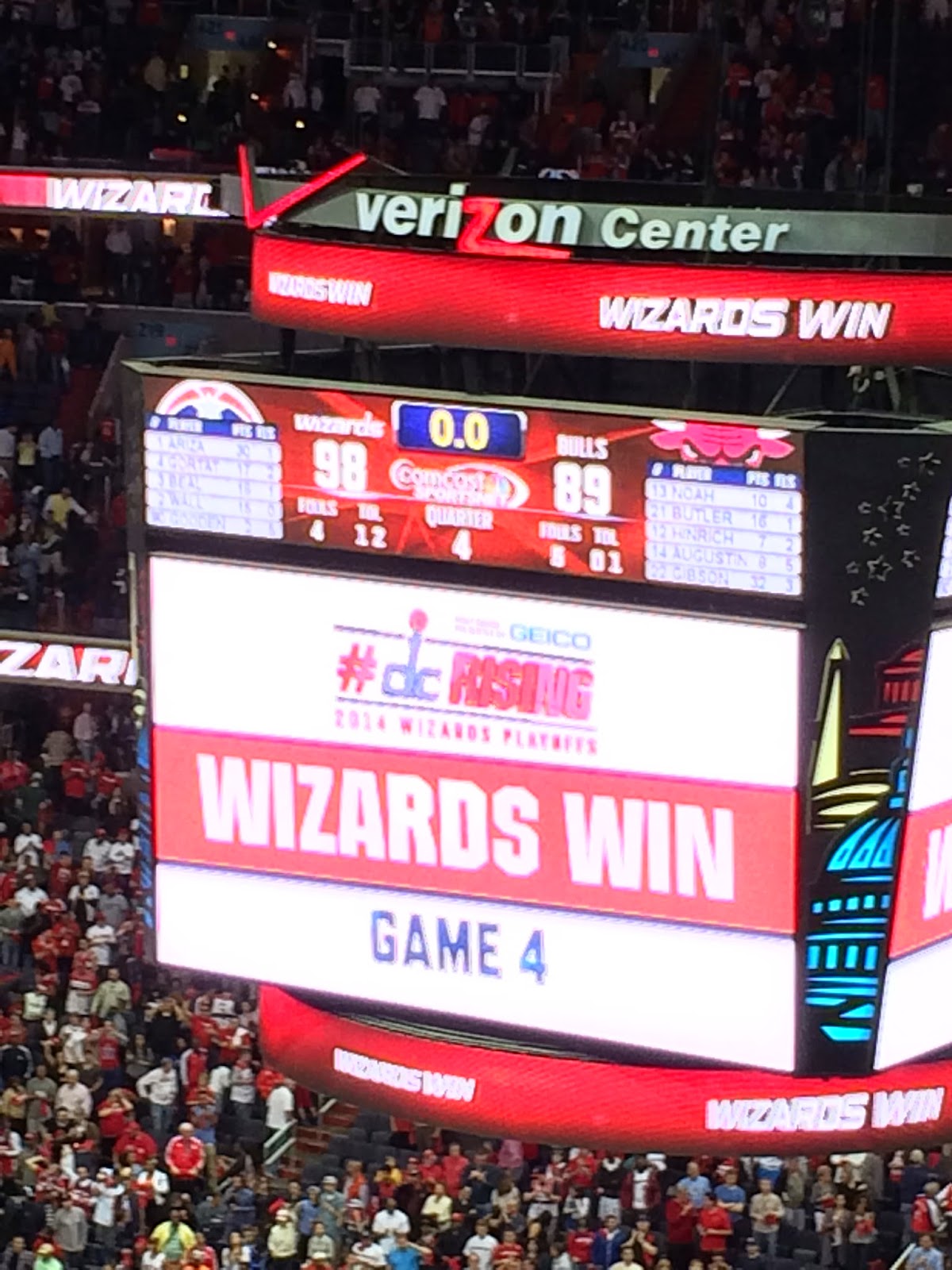
Wizards Win Game 3 Against Bulls!


Peter Eelman and I have season tickets to the Wizards.   Peter was out of town so Julie and I went to the Wizards game this past Sunday and saw a GREAT game where the Wizards beat the Bulls in game 3.  The Wizards then closed the series on Tuesday in Chicago.  On to Round Two with the winner of the Hawks-Pacers series.


Tuesday, April 29, 2014

The Last Metre - Memex Automation's Leadership in Connectivity on the Manufacturing Floor


I wrote an article at Memex Automation, called The Last Metre.

Below is a snippet at the beginning.

What is the last metre?  The last metre, or last meter if you live in the United States, is the combination of technical, and sometimes business, challenges involved to make the final connection of a device to the Internet.   A device would be any device from a multi-million dollar machine tool to an inexpensive sensor.

Many have heard of “the last mile problem” as it relates to the challenge of connecting a house to the Internet.  Solving “the last mile problem” can be quite complicated and costly with legal right of ways, homeowner associations, and local politics and of course homeowner concerns.   Solving the last metre is exponentially more complex because of the number and types of machines and devices on the manufacturing floor.  At Memex, we know how to solve the last metre on the manufacturing floor and we know our methodologies and toolkits can provide the platform to solve the last metre problem in a variety of non-manufacturing industries.

Monday, April 21, 2014

Bosch and Pratt & Miller - Forward Focus Collision Avoidance


I saw this technology on a Corvette Forum.  Extremely cool!


Wednesday, April 16, 2014

Seven year anniversary of the tragedy at Virginia Tech.

Today is the seventh year anniversary of the tragedy at Virginia Tech.

My thoughts and prayers go out to all the families, relatives and friends of those who lost their lives on April 16th, 2007 in this senseless tragedy.....

The picture below was on the Collegiate Times in 2007 at VT:
 
There is a permanent memorial at VT. The Collegiate Times has a nice article describing the memorial.
My memories of last April 16th started with a phone call from my wife. Julie called and said, "just wanted to let you know that John is fine." At the time I was on my SunRay reading email while on a con call when she called my cellphone. She never calls me during theday since she is a school teacher. "Why would John not be be fine?" I asked. She asked me if I was watching TV or listening to the news. Of course I was not watching TV or listening to the news. She explained what was going on. I immediately interrupted the Sun folks on the con call and quickly said, "I had to get off the call, there was a shooting at my son's school."
It was then that I turned on the TV and was shocked to see the peaceful and beautiful VT campus on the news. I started getting emails, phone calls from literally around the world checking on John. You sometimes forget in casual conversation that you mentioned something about your kids that your friends and colleagues remember. Every time a call came, I paused the DVR. I was getting the current updates from friend, colleagues\s and family all around the world via email and non stop phone calls. As the numbers kept rising, it became more and more surreal.
 My son John was working for the Collegiate Times during his freshman year.  He put together a very nice week long history of events starting on April 16th through April 23rd that shows what happened each day.
I can not imagine the horror the students and faculty must have felt. There was an article in the post today by Nick Miroff, titled, "A Year Later, Virginia Tech Is Still Healing" is a well written article worth reading. As Miroff points out:
"Virginia Tech students have learned to talk about it in shorthand, if they talk about it at all. This Story
They do not use the words massacre, or
shootings, or rampage. They call it "April
 16th," and sometimes not even that. To
 say "four-sixteen" is enough. Everyone
 knows." 
I have been back to VT many times since April 16th, 2007 both as a parent and working for Sun Microsystems where I have given talks and brought down Sun's thought leaders to speak at VT's ACM where my son John is President.  Each time, the first thing I do is visit the memorial
          Governor Kaine has did a good job demanding there was the VT Task Force.  Governor Kaine stated:
"On April 16, 2007, Virginia Tech University suffered a terrible tragedy. Today, my thoughts and prayers are with the victims and their families and the entire Virginia Tech community.
"In the year that has passed since that horrible day, we have grieved for those we lost and prayed for the comfort of their loved ones. We have rejoiced in the recovery of those who were injured. We have been inspired by the unfaltering hope and Hokie spirit of Virginia Tech. And we have renewed our commitment to do even more to learn lessons from that day and to make our campuses and communities safer.
"As I think about the victims' families, I am at a loss for words to express what is in my heart. The courage and strength they have shown in the face of such tremendous, tragic loss is awe-inspiring. We have been inspired by the resilient Hokie spirit of Virginia Tech, both in Blacksburg and around the world. Since that tragic day last April, the unshakeable sense of unity and hope demonstrated by the Hokies has touched the lives of people around the world. Their focus on pulling together to support their school and each other in the days after the shooting, and their commitment to public service through the VT Engage program in the months that followed has moved us all.
"We still have work to do. A continued commitment to improvement is the best tribute we can pay to those who lost so much. And as we move forward, we will continue to be inspired by those in the Hokie Nation."


VT seems to have made the right changes. The VT Task Force seemed to not pull any punches when it came to how the University should have dealt with the events on the morning of April 16th, 2007. As the AP reported and I FULLY AGREE with Governor Kaine about purchasing firearms at gun shows. Virginia needs to get its act together.  This loophole is INSANE!

"Gov. Timothy M. Kaine proposed mandated background checks yesterday for everyone who attempts to purchase firearms at gun shows - legislation that he called critical to helping prevent future tragedies like the shootings at Virginia Tech. Many families of those killed or injured in the April shootings have called on legislators to close Virginia’s so-called gun show loophole, which allows people to purchase firearms from unlicensed sellers at gun shows without having to submit to background checks. Under current Virginia law, only licensed dealers are required to run background checks on customers.
“If by doing this, we can keep one family from having to go through what these families have suffered, it will be the best thing that the legislature will do this year,” Kaine said at Virginia State Police headquarters, surrounded by several of the victims’ families."

VA continues to be a backward state and allows the gun show loophole.   I also called into the Kojo Nnamdi Show when he had an anniversary show on the VT shooting.   If you go to the 11:52 mark, you can hear my statements and question that goes until the 13:14 mark.


"Courage is the first of human qualities because it
is the quality which guarantees all others."


Winston Churchill

The tragedy at Virginia Tech is still heart wrenching. As a parent of a VT freshman, it is still hard to comprehend the magnitude of this tragedy. There
were many heroes on VT's Campus on April 16th, 2007.
Many
are well documented in the press.

There are five individuals who were behind the scenes
that are absolute heroes in my mind
. Those five heroes are
the individuals who run online Collegiate Times which is
VT's main online paper and kept the world informed on the
latest breaking news coming out of VT on this senseless
tragedy. These five individuals were literally working
around the clock, giving up sleep to keep their fellow
students, parents, family, friends, faculty and the rest of
the world informed.


These five unsung heroes
all have the "first of human
qualities" - courage. It would have been perfectly
understandable if these five individuals would have given
up when their servers went down. But they did not. They
had the courage to literally work around the clock to get
the server back up *and* keep the rest of the world
informed of the latest updates to one of the most of
horrific days in the history of our country.
The five
individuals are:


Chris Ritter, Online Director
Tim Tutt, Web Developer
John Edstrom, Associate Web Developer
Gabriel Martinez, Associate Web Designer
Collin Smith, Multimedia Editor


One of the many amazing statistics is that the
Collegiate Times received up to 53 million hits
by
early afternoon on Monday April 16th.

Wikipedia has a nice history of the Collegiate Times with the
picture that appeared on the Collegiate Times April 17th, 2007,
edition titled "Heartache."


Below are just some of quotes on the fantastic work that
these five unsung heroes did under
tremendous pressure.


The OnLine Newshour on PBS

"The Internet became a prime place for people to
get the news out of Blacksburg.
The college
newspaper, the Collegiate Times, scooped the major
media, getting the story online, right after the
first shot rang out, and staying on it non-stop
ever since.


The 104-year-old paper received up to 53 million
hits by early Monday afternoon,
forcing the site
down for a time. It also listed some of the dead
early Tuesday morning,
prompting the New York Times
Web site and other news outlets to link to the
Collegiate Times."

The Shield - University of Southern Indiana Student Newspaper
"The information on the Web site is remarkable.
Besides the list of confirmed deceased, the site
provides a graphic map of the shootings, a photo
gallery, personal accounts and interviews and
related stories ranging from emerging donation
details to the impact on the nearest hospital. The
staff has handled the facts correctly, but not
without compassion, which is a difficult task.


The Collegiate Times editorial says, "When
considering the number of deceased victims, 32 is
devastating, but those lives are not just a number,
each one is a member of our community." Journalism
cannot be disregarded due to a personal tragedy,

since citizens rely on journalists for information.
Such journalists must remember, however, that
although horrific tragedies stir media attention as
sensational, there is nothing sensational about
human suffering and coverage must be conducted
tastefully.

Well done Collegiate Times staff.

To those that believe campus newspapers are a waste
of time and funding, let this tragedy serve the
purpose of proving the necessity of campus
newspapers nationwide."
Chronicle of Higher Education

"National Public Radio is among news organizations
that have profiled and praised Virginia Tech
student newspaper, The Collegiate Times, which has
become a crucial source of information for other
reporters covering Monday's events.


The papers online edition, said NPR's Larry
Abramson, has grabbed international attention
indeed, on Tuesday The New York Timess home page
linked to the student publications list
of
confirmed victims of the shooter. Mr. Abramson
also pointed out that Collegiate Times staff
members know how to mine Facebook for information
inaccessible to many older reporters who are
unfamiliar with the social-networking site
." -
WGHP Fox TV VIDEO:


"The team at The Collegiate Times, the campus
newspaper, will remain. So far, they have been
setting the pace for all journalists"
Middlebury Campus


"The face of a crisis, the writers, photographers
and editors of Virginia Tech's student daily,
The
Collegiate Times, transcended their roles as
college journalists to not only inform their
community, but to inform the world. With many local
news sources shut out, only limited comments coming
from Virginia Tech officials and an entire campus
on lock-down, the importance of these students'
work was heightened to an extreme.
The written,
photographic and video posts to The Times website
throughout the day were among the most vivid and
honest portraits of the campus available.
Working
from computers outside of their offices, the
students held nothing back, and produced a raw,
emotional narrative of the tragedy. Their reporting
was effective, critical and in every sense, brave."


Editor and Publisher


"While the editors of the student newspaper went
about their work with inspiring leadership,

internal communications by Virginia Tech
administrators showed the University was less than
fully prepared. As more and more details about the
sequence of events have been released, it has
become clear that administrators did not notify the
entire campus or order a full lockdown until more
than two hours after the first round of shooting
began. Whether or not any of the deaths in the
second round of shooting could have been avoided,
we should realize the need for all institutions to
prepare for the unimaginable. And
in the face of
this shooting, college administrators everywhere
should recognize the need to share information with
their communities quickly and clearly, even as the
full extent of a crisis may remain unknown."


"The college paper at Virginia Polytechnical
Institute kept a running account of the tragedy
that struck the campus today,
with more than 30
students gunned down in at least two areas of the
campus, a dorm and a classroom. The shooter is
allegedly dead as well, but not identified. It is
not known if he was a student ...

Here is how the student-run Collegiate Times
reported it, blog-style, with the most recent
posting first.
A full article is now posted there,
which includes the note that police "are also
investigating if it has any relation to the recent
bomb threats on Tech's campus."


Seattle Post Intelligencer


"For unique reporting on the massacre read the
Collegiate Times, Virginia Tech's student-run
newspaper."
University Daily Kansan

"While news organizations like CNN have done a
thorough job in covering Monday's events, I'd like
to point the readers of kansan.com to Virginia
Tech's student newspaper, the Collegiate Times.
After overcoming early technical difficulty when
the news initially broke, they've done what I feel
is an admirable job as the student voice of the
Virginia Tech community.


In the process of learning about these tragic
events, be sure to not overlook the students
themselves. http://www.collegiatetimes.com"
WRAL

"I found a couple sites with unique angles on this
story. One of the most interesting is The
Collegiate Times, which is VT's student newspaper.

Their staff apparently first reported this shooting
this morning. The server is overwhelmed right now,
but it will be interesting to check their coverage
in the days and weeks ahead."
Forbes

"M
onday's shooting at Virginia Tech provided a
grim, real-time stress test for the effectiveness
of Web 2.0 technologies. And on Monday, all of them
seemed to work: Information flew through text
messages, blog posts, Web sites, online videos and
social networking sites.


The Internet reacted to the event immediately--and
more quickly than Virginia Tech administrators, who
took two hours to warn students, via e-mail, about
a first shooting. The Web site of VT's student
newspaper, the Collegiate Times, crashed when
students flooded it after the first shooting. As a
replacement, students created a low-tech blog,
CollegeMedia.com.

It posted the first entry about the event at 9:47 a.m.,
minutes before the second shooting began."

Yahoo News

"The student newspaper, the Collegiate Times,
regularly updated its website proving to be a
valuable resource for the campus as well as the
national media."
Daily Californian


"And as this happened, students at the Collegiate
Times, the Virginia Tech student newspaper, were
able to live-blog the days events. The Web site
began the day with a post at 9:47 a.m. EST,
reporting Shots were fired on campus and
provided continuing updates throughout the day. The
entries of the papers staff provide an
illuminating window into the fear and questioning
that doubtless gripped the campus in those
uncertain hours."


"The Collegiate Times, Virginia Tech's campus newspaper,
was the first media outlet to break the story Monday with
on-line reports of shots fired on campus."
Manhattan Mercury

"No amount of on-the-job experience or education
could have prepared Kelly Furnas
for what he's
faced this week in his capacity as an editorial
advisor to the campus newspaper at grief-stricken
Virginia Tech University.

.....

To be honest its been pretty much non-stop working
with the student newspaper I have not had time on a
personal level to sit down and digest everything
yet," Furnas said.

The Collegiate Times, Virginia Tech's campus
newspaper, was the first media outlet to break the
story Monday with on-line reports of shots fired on
campus.

"I can't put into words how proud I am of our
students,"
Furnas said. "They have provided
desperately needed information to their readers,
and they have done that with gusto. I think the
campus newspaper's reputation with the students
here has helped a lot."


The Age (Australia)

"'The school's student newspaper, The Collegiate
Times, filed up-to-the-minute online dispatches.
At
4.44pm: "Police have confirmed that the shooter
took his own life." At 4.54pm: "University
Relations has confirmed 31 deaths at Norris Hall,
in addition to two deaths at West Ambler Johnson."
Gulf Times

The Collegiate Times (its server quickly crashed
and a blog written by editors with messages from
students appeared instead on the web site of the
newspapers owning company), as well as to media
outlets around the world, including CNN and the
BBC. Regardless of where the contributions are
aimed, the back and forth on facebook.com and other
social networking sites are equally an instant and
new resource for news producers and reporters


NPR


"As reporters from around the world descend on
Blacksburg, Va., one publication stands out:
Virginia Tech's student newspaper, Collegiate
Times, is doing a truly remarkable job of covering
the story."


About 15 staff members were rushing to update the
site about every 15 minutes with news of the
convocation, shooting investigation and candlelight
vigil plans.


"We're getting like 10 billion phone calls,
everyone from Al Jazeera to tiny radio stations in
Iowa,"
Kendall said.
LA Times


"The paper's scoops included eyewitness accounts of
the shootings, interviews with a classmate of the
shooter and a list of victims' names that was
posted late Tuesday
. A reporter was one of the
first to question administrators about why they
didn't warn students during the two hours between
the two shootings Monday morning."

Poyneronline

"The Web staff for Virginia Tech's student
newspaper, The Collegiate Times, was also
scrambling for solutions after its servers crashed
around 10:30 a.m. the day of the shootings.

Online editor Chris Ritter's main goal was to get
the site back to its original state -- a large,
graphical and Flash-intensive homepage. When that
couldn't happen, Ritter and his staff opted for a
simple text page with blue background -- to ensure
they could communicate information quickly to
users
. After that page continued to overload its
own server, The Collegiate Times tech adviser,
Scott Chandler, suggested that the staff use the
College Media server, the parent company which
hosts the publication's site.

Once the site stabilized on the additional server,
The Collegiate Times began posting photos and
videos to a third server usually reserved for
design research and development. To prevent
crashing again, a Virginia Tech server is now
hosting videos and photos for the site.


Monday night The Collegiate Times staff redesigned
its homepage from scratch to have a Web site
that
was "intuitive and a graphically pleasing display"
of its special content for the shootings. The
Collegiate Times began creating breaking-news
multimedia when escaped convict William Morva shot
two police officers at Virginia Tech on the first
day of school last August.

Since then, Ritter said users are looking at the
Web for information more than ever before, and the
staff has adopted a Web-first attitude change."

Roanoke Times on CT:
Coping Through Journalism Video


Hopefully the healing will continue for those directly affected...